What Quartz Cost the Trade
When accuracy stopped being rare, the trade lost its strongest argument.
01The price of a solved problem
For three centuries, the mechanical watchmaker's central promise was simple: a good movement, correctly regulated, would tell you the time. That promise was hard to keep. It required a compensated balance, a well-finished lever escapement, a seasoned mainspring, and years of trained hands. Isochronism — the property of an oscillator that swings in equal time regardless of arc — was a goal pursued across entire careers. Every element of the going train, from the fusee curve to the depth of each wheel-and-pinion mesh, existed to protect the rate.
Then, in the 1970s, a quartz crystal in a cheap plastic case kept better time than a precision marine chronometer.
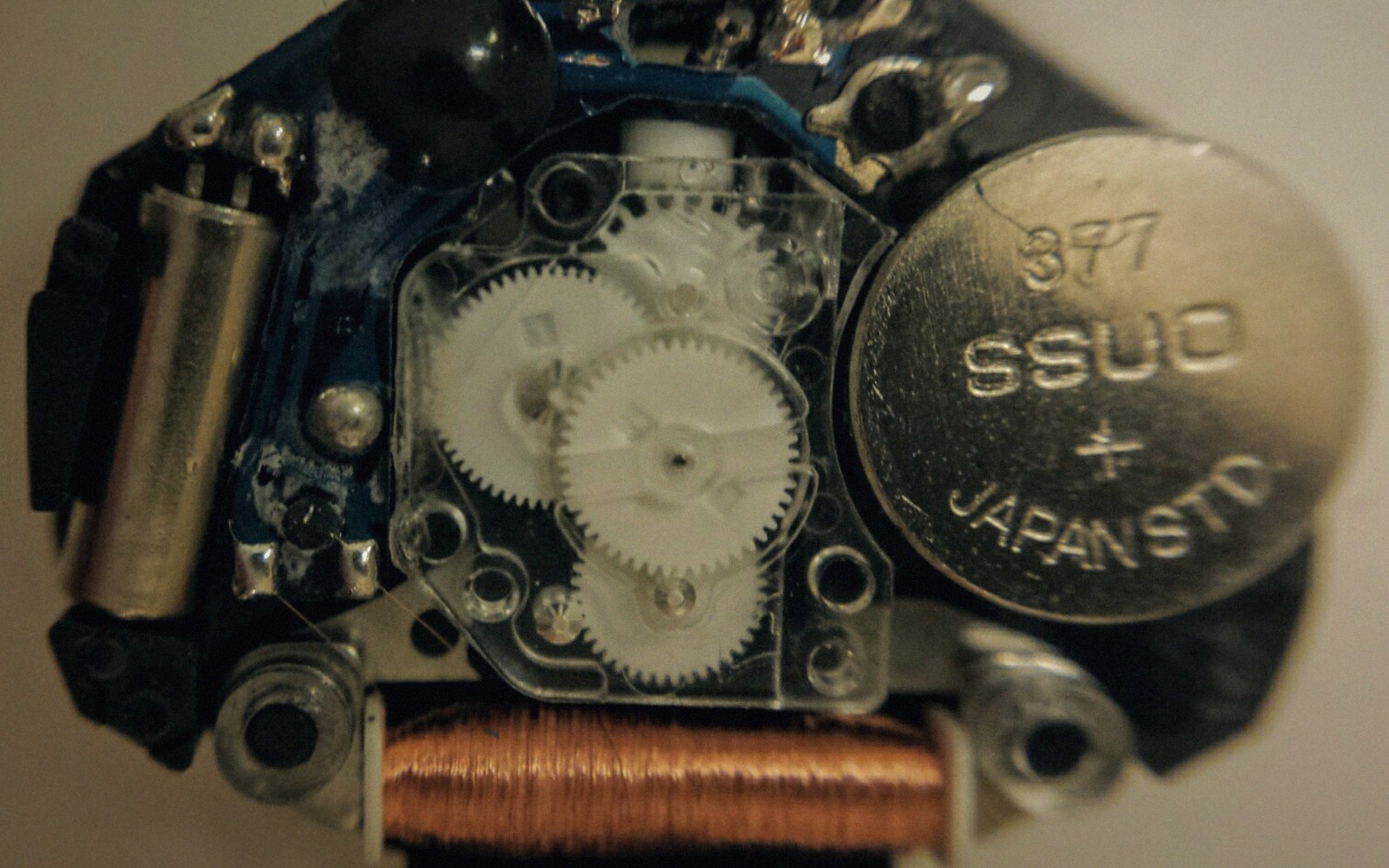
The disruption was not gradual. Japanese manufacturers, led by Seiko with its Astron of 1969 and the subsequent wave of mass-produced movements, compressed decades of mechanical refinement into a component that cost almost nothing to replicate. A quartz oscillator vibrates at a frequency set by the geometry of the crystal — typically 32,768 Hz in a wristwatch — and a small integrated circuit counts those vibrations and drives a stepping motor. There is no escapement to adjust, no balance staff to replace, no oil to degrade. The Royal Observatory Greenwich had spent two centuries pursuing accuracy as a technical frontier; quartz moved that frontier somewhere a factory could reach.
The casualties were specific and swift. Swiss ébauche — the rough-movement — factories that had supplied the industry for generations closed or shrank dramatically through what the trade remembers as the "quartz crisis," a term used without irony by the Federation of the Swiss Watch Industry in its own historical documentation. Employment in the Swiss watch industry fell by roughly half between the mid-1970s and the mid-1980s. The skills most affected were precisely those hardest to learn: escapement finishing, temperature compensation, positional regulation.
What survived reframed itself. A mechanical watch, once it could no longer compete on accuracy, had to compete on other terms entirely — craft legible to the eye, a going train that rewards inspection, the particular satisfaction of a mechanism that neither needs nor contains a battery. These are real values, but they are aesthetic and tactile, not horological in the original, navigational sense. The trade that once answered to the Board of Longitude answered, from the 1980s onward, to a different brief.
Accuracy became a commodity. Everything else became the argument.
Chronology
In order
- 1969Seiko Astron released; quartz enters the consumer market
- 1970s–80sthe "quartz crisis" reshapes Swiss and European trade
- 1980s onwardmechanical watchmaking repositions around craft and aesthetics