01The problem quartz did not quite escape
A mechanical chronometer's struggle with temperature is visible in the mechanism: compensation balances, gridiron pendulums, bimetallic strips. The battle is physical and, to a craftsman, legible. Quartz seems to sidestep all of that — no metal rod to lengthen, no spring to soften — but the crystal itself has a thermal sensitivity, and ignoring it produces a timekeeping error just as real as any escapement fault.
The frequency at which a quartz resonator vibrates depends on the elastic stiffness of the crystal lattice. Heat changes that stiffness. The result is a frequency-versus-temperature curve that is not a straight line but a cubic — the rate rises, peaks, falls, and bottoms out across the working temperature range. Where a mechanical compensation balance fights a roughly linear effect, quartz presents a curve with a shape that the designer must either exploit or flatten.
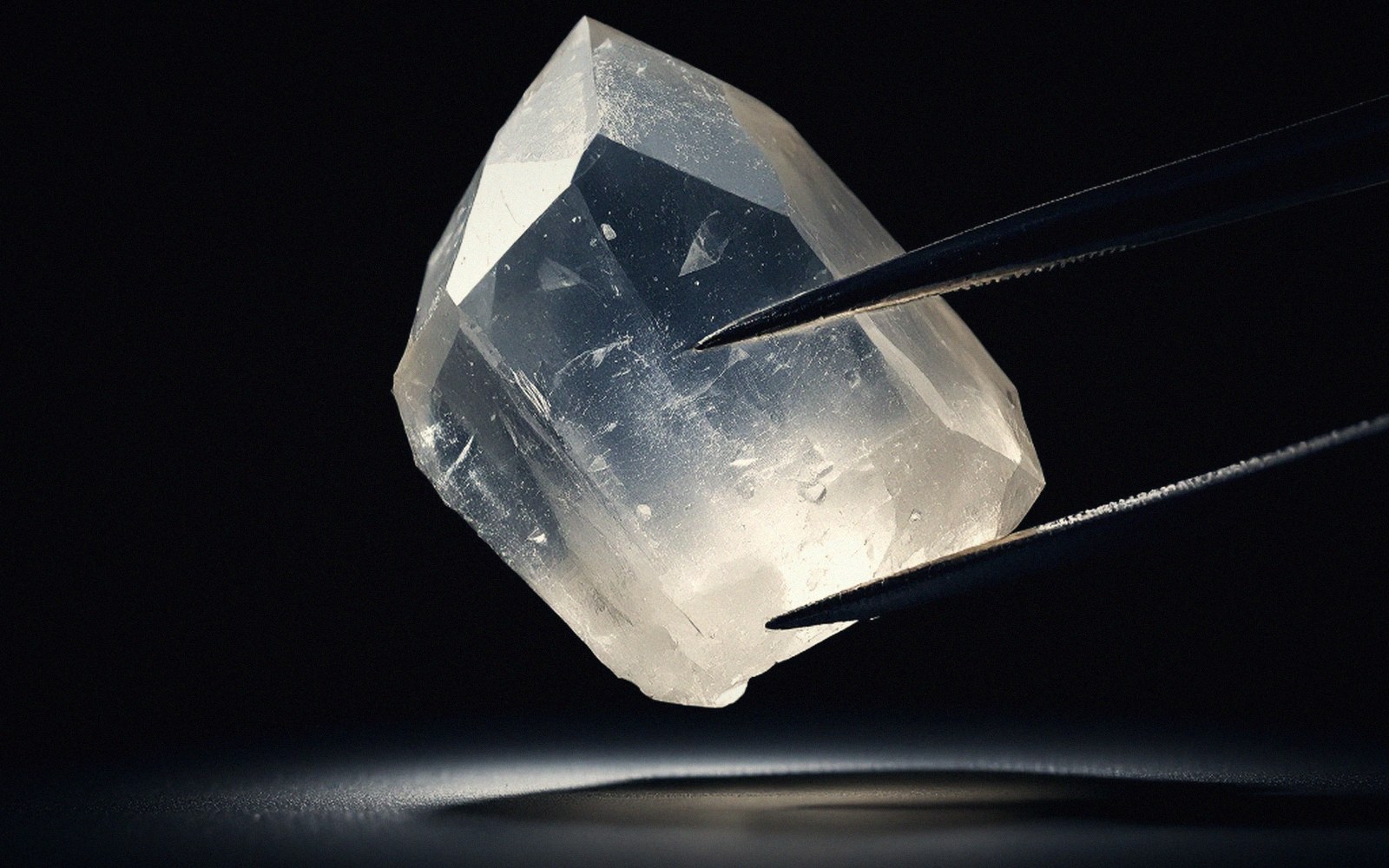
The solution arrived with the AT cut, a slice through a synthetic quartz blank at approximately 35 degrees and 15 minutes to the optical axis. Discovered through systematic experimental work in the 1930s and refined over subsequent decades, the AT cut places the inflection point of that cubic curve near room temperature. The slope at that inflection point approaches zero — meaning a small change in temperature produces a negligible change in frequency. It does not eliminate the curve; it rotates it so the flattest part coincides with where the crystal will actually operate.
For wristwatches and domestic clocks the AT cut is sufficient. For instruments held to tighter standards — frequency standards used in telecommunications infrastructure, for instance, or laboratory references — designers go further. They mount the crystal in a temperature-controlled oven held a few degrees above any likely ambient, a device known as an OCXO, an oven-controlled crystal oscillator. The crystal then sits permanently at the peak of its own curve, where the slope is effectively zero.
The irony is clean: quartz escaped the mechanical engineer's compensation problem and handed it to the materials scientist and the thermometer. The physics is different; the discipline of accounting for temperature is not.
Chronology
In order
- 1930ssystematic investigation of quartz cuts and their thermal behaviour establishes the AT cut as the workhorse of precision timekeeping
- Post-WWII decadesOCXO technology matures, entering telecommunications and metrology before filtering into laboratory standards
Read next in V · Quartz
3 entries in this section · section page- V · QuartzThe crystalA quartz sliver vibrates at a frequency set by how it is cut, and it is far more stable than anything mechanical.Read the entry →
- V · QuartzWhat quartz cost the tradeAccuracy became cheap almost overnight, and an entire industry had to argue for itself on other grounds.Read the entry →