The Crystal
A quartz sliver vibrates at a frequency set by how it is cut, and it is far more stable than anything mechanical.
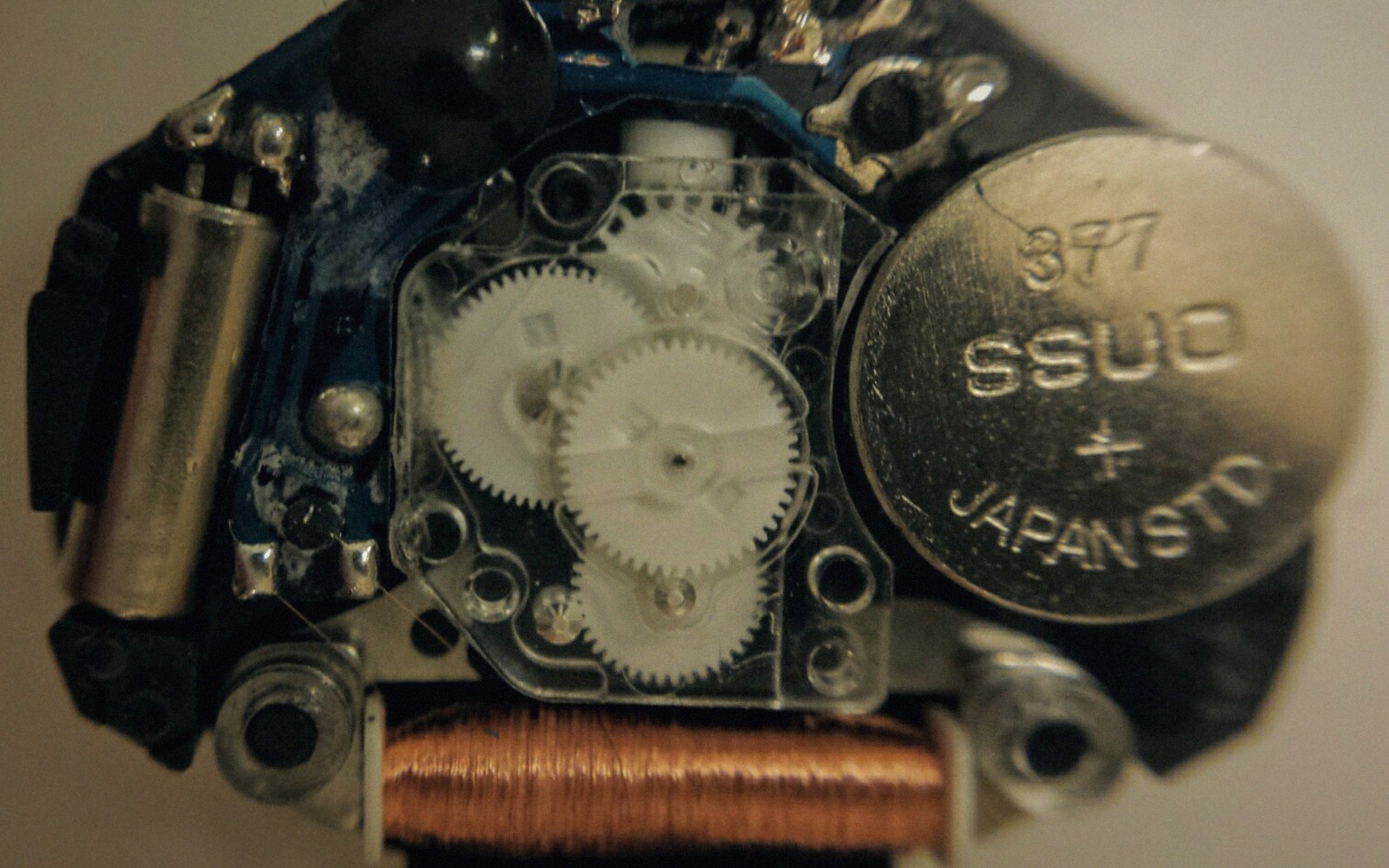
01How a sliver of stone replaced a century of clockmaking ingenuity
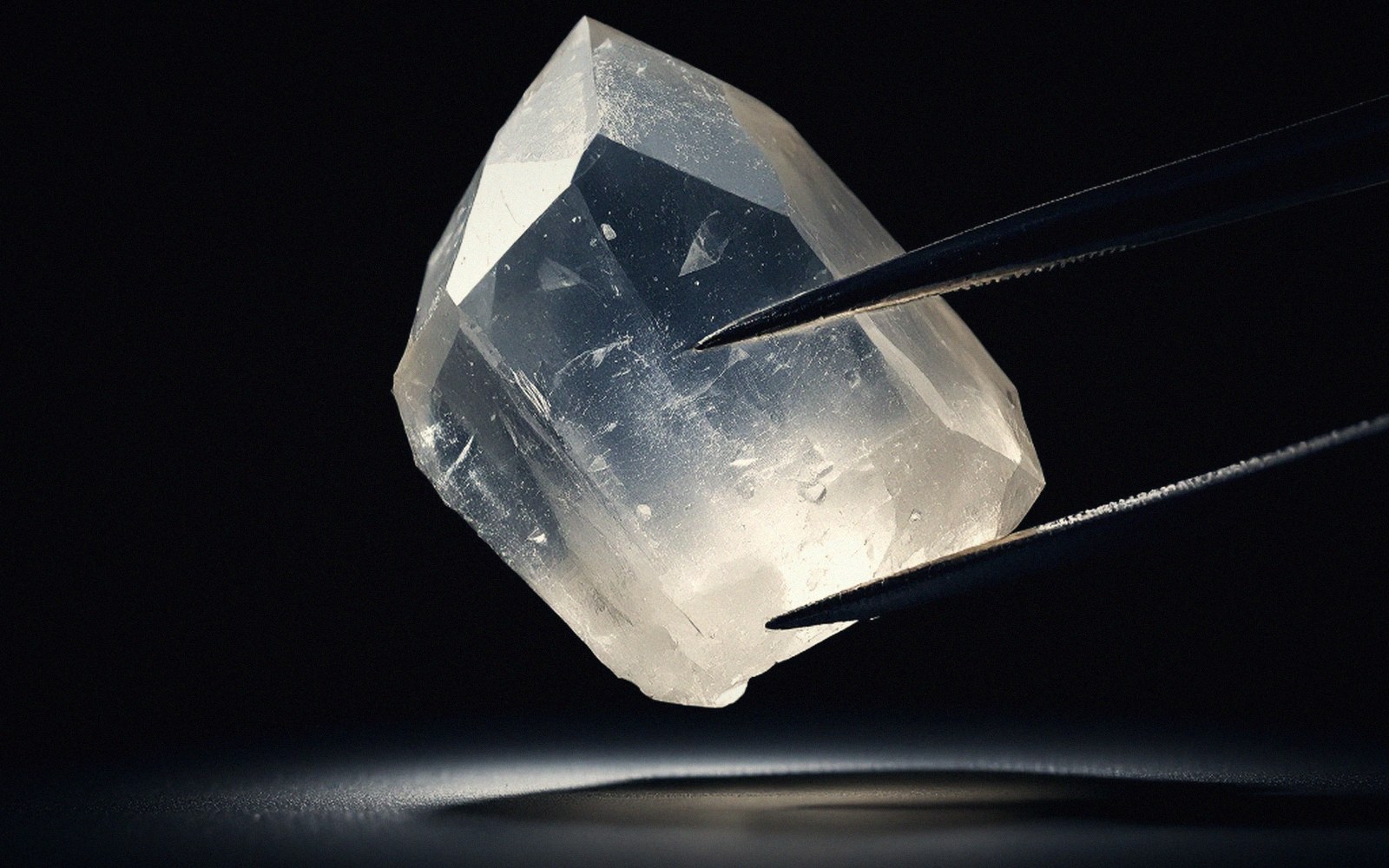
Quartz is piezoelectric — squeeze it, and it produces a voltage; apply a voltage, and it vibrates. That second half of the exchange is the one that changed timekeeping. Cut a sliver of quartz to the right dimensions, drive it with a small oscillating electrical signal, and it rings at a frequency governed almost entirely by its own geometry. The resonator does not care about gravity, the ship's roll, or the state of its lubricants, because it has no pivots, no levers and nothing that needs oil. It is a piece of rock doing the job that centuries of ingenious mechanics had tried and only partly solved.
The frequency depends on cut. A disc, a tuning-fork shape, an AT-cut plate — each geometry brings out a different vibrational mode in the crystal lattice. The AT-cut, sliced at roughly 35 degrees to the crystal's optical axis, became the dominant choice for precision timekeeping because its frequency-temperature curve is relatively flat near room temperature. Flatter means more stable: a clock that ticks slightly differently in summer than winter accumulates an error; one whose tick barely changes with temperature does not. Temperature again turns out to matter just as much for quartz as it did for the pendulum, only now the solution is in the angle of a saw cut rather than a gridiron of alternating metals.
02From laboratory curiosity to wristwatch
The first quartz clock, built at Bell Laboratories in 1927 by Warren Marrison and J.W. Horton, occupied a room and needed mains power. Its stability was immediately startling — good enough that when astronomers at the Royal Observatory Greenwich began using quartz standards in the 1940s, they could show that the Earth itself varied in rotation speed. The planet turned out to be the unreliable partner. That finding, quietly epochal, would eventually force a redefinition of the second away from astronomy altogether.
Miniaturisation took decades. The engineering problem was not merely making the crystal smaller — smaller crystals vibrate at higher frequencies, which has to be divided electronically down to one pulse per second — but making the entire oscillator circuit stable, low-power, and cheap enough to manufacture at scale. The 1969 Seiko Astron, sold in Tokyo on Christmas Day of that year, was the first quartz movement in a wristwatch. Within a decade the price of quartz movements had fallen so far that mechanical watchmaking, a craft refined across four centuries, was fighting for commercial survival.
03What the crystal cannot do alone
A quartz resonator is not magic. It is a physical object, and physical objects have imperfections. A crystal vibrating at, say, 32,768 Hz — the standard tuning-fork frequency in a wristwatch, chosen because it is exactly 2 to the 15th power, making digital division straightforward — still drifts if its temperature drifts, ages as internal stresses relax over time, and performs differently depending on how it is mounted. The electronics around it introduce their own errors. Consumer-grade quartz oscillators are typically accurate to within a few seconds per month, which already exceeds any purely mechanical movement. Precision quartz oscillators used in instrumentation, held in temperature-controlled ovens and aged before use, can hold time to a few microseconds per day.
The materials science matters too. Synthetic quartz, grown hydrothermally from a seed crystal, is now preferred to natural quartz for any serious oscillator because it can be produced with fewer inclusions and a more predictable lattice structure. Natural quartz from piezoelectric deposits in Brazil was adequate for early work; the demands of modern communications and positioning infrastructure required something more consistent.
What the quartz resonator ultimately provides is a reference frequency that is orders of magnitude more reproducible than the best mechanical oscillator ever made. William Hamilton Shortt's free pendulum, the pinnacle of mechanical timekeeping in the 1920s, was accurate to about a second per year under ideal conditions. A disciplined quartz crystal does that by mid-morning. The crystal did not just improve on the pendulum — it made the pendulum's entire problem domain irrelevant, which is a different kind of victory.
Chronology
In order
- 1927Marrison and Horton build the first quartz clock at Bell Laboratories
- 1940sRoyal Observatory Greenwich adopts quartz standards; irregularities in Earth's rotation become measurable
- 1969Seiko Astron, first quartz wristwatch, sold in Tokyo