Why Longitude Is Time
The Earth turns fifteen degrees every hour. Solve the clock, and you solve the map.
01The Geometry That Made Clocks Into Instruments
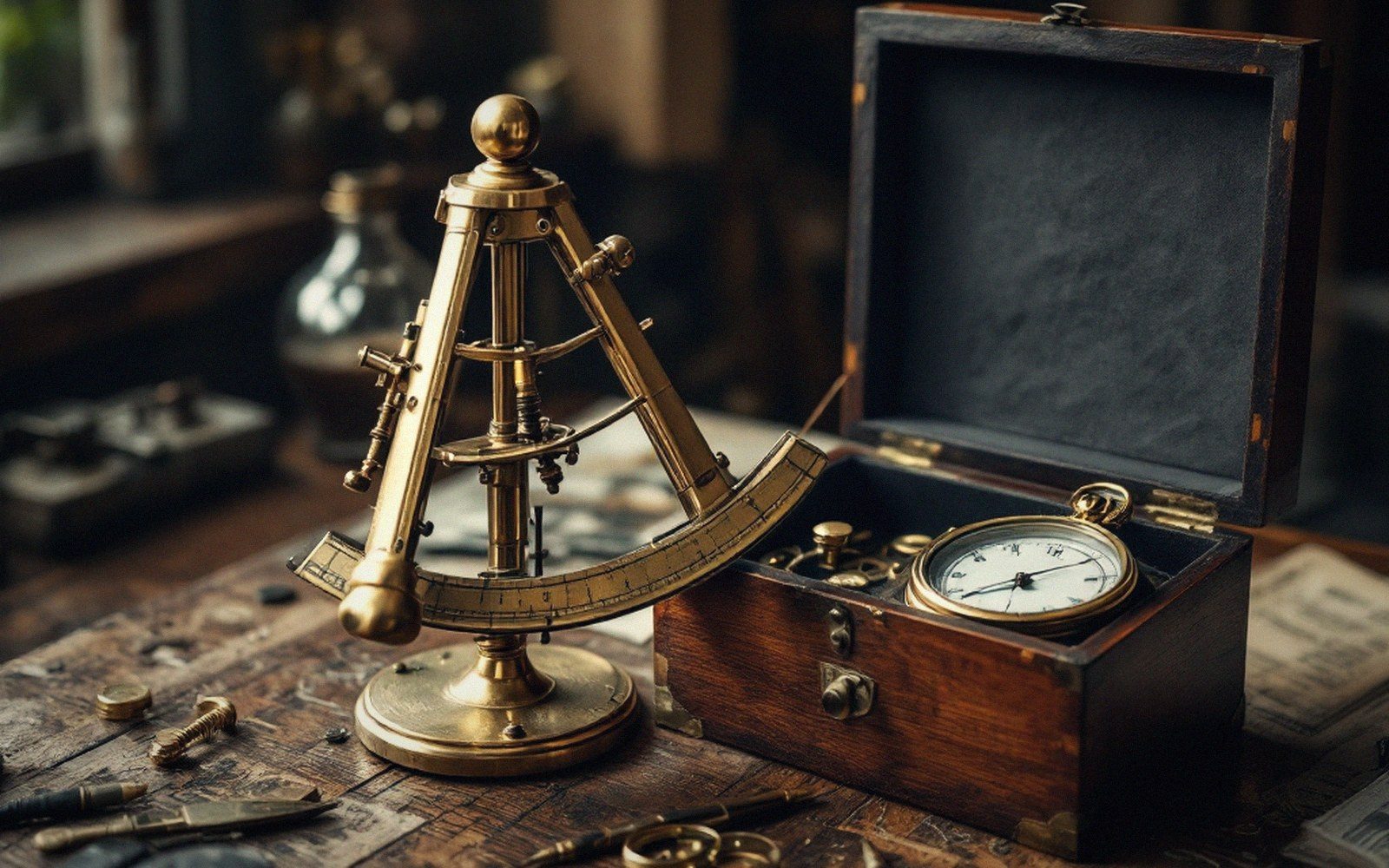
Latitude is easy. The height of the Pole Star above the horizon, or the noon altitude of the Sun, tells a navigator where he stands north or south of the equator — a matter of angle, solvable with a quadrant or sextant and nothing else. Longitude is another problem entirely. There is no fixed celestial marker to measure east or west against. The sky rotates, and so does the ship beneath it.
The Earth turns on its axis once in twenty-four hours, sweeping through 360 degrees of arc. Divide one by the other: fifteen degrees of longitude pass beneath the Sun every hour, one degree every four minutes. That ratio is fixed by geometry, not convention, and it turns the problem of position into a problem of time. If you know the exact moment of local noon — when the Sun peaks overhead — and you also know what time it is at that same instant back at a reference meridian, the difference in hours multiplied by fifteen gives your longitude in degrees. East of the reference if your local noon comes first; west if it comes later.
The reference the world settled on is the meridian running through the Royal Observatory Greenwich, established by Charles II in 1675 specifically to support navigation. Greenwich Mean Time became the anchor. A ship a full hour behind Greenwich is fifteen degrees west; six hours behind, ninety degrees west — far beyond the Atlantic, in central North America.
The snag was carrying Greenwich time to sea. A sundial gives local noon anywhere. What it cannot give is a simultaneous reading of noon at home. That requires a clock set before departure and running faithfully throughout a voyage of weeks or months — through roll, damp, and temperature swings that defeat ordinary mechanisms. The Board of Longitude, established by Parliament in 1714, offered £20,000 for a method accurate to half a degree — equivalent to keeping time to within about three seconds a day at sea over a six-week crossing.
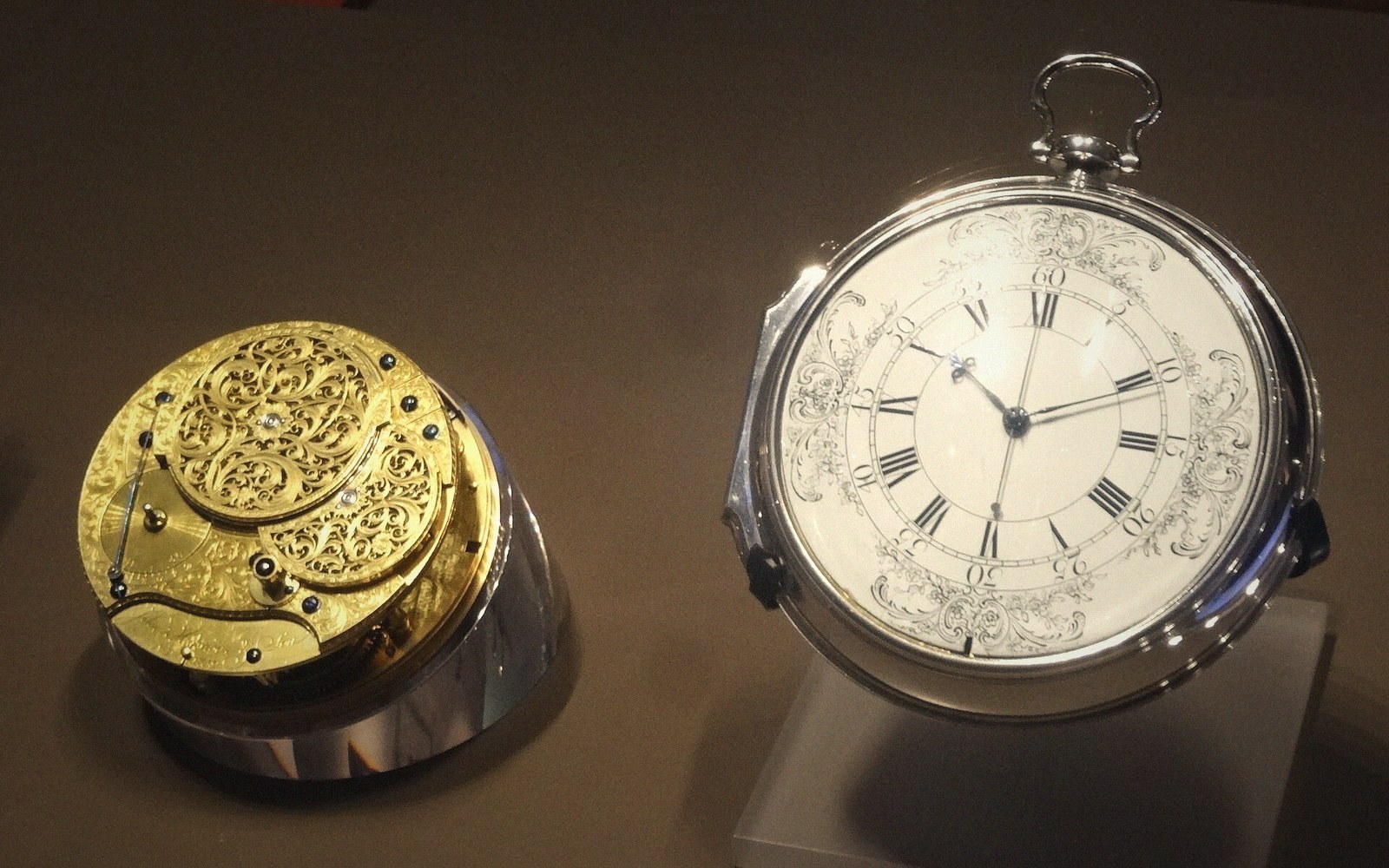
Half a degree of longitude at the equator is roughly fifty-five kilometres. Ships had been missing coastlines, running onto rocks, and losing entire fleets for want of those fifty-five kilometres. The prize was enormous because the cost of failure was enormous.
The relationship between time and longitude is exact, indifferent, and unforgiving. It demanded a new class of instrument — one that could hold its rate through every condition the ocean imposed — and in demanding it, it set the course of precision timekeeping for the next two centuries.
Read next in I · Longitude
3 entries in this section · section page- I · LongitudeHarrison's H4Finished in 1759 and now at the Royal Observatory, a large watch that kept time well enough to find longitude across an Atlantic crossing.Read the entry →
- I · LongitudeThe sea defeats a clockRoll, damp, salt and temperature swings break every assumption a room clock makes.Read the entry →