Harrison's H4
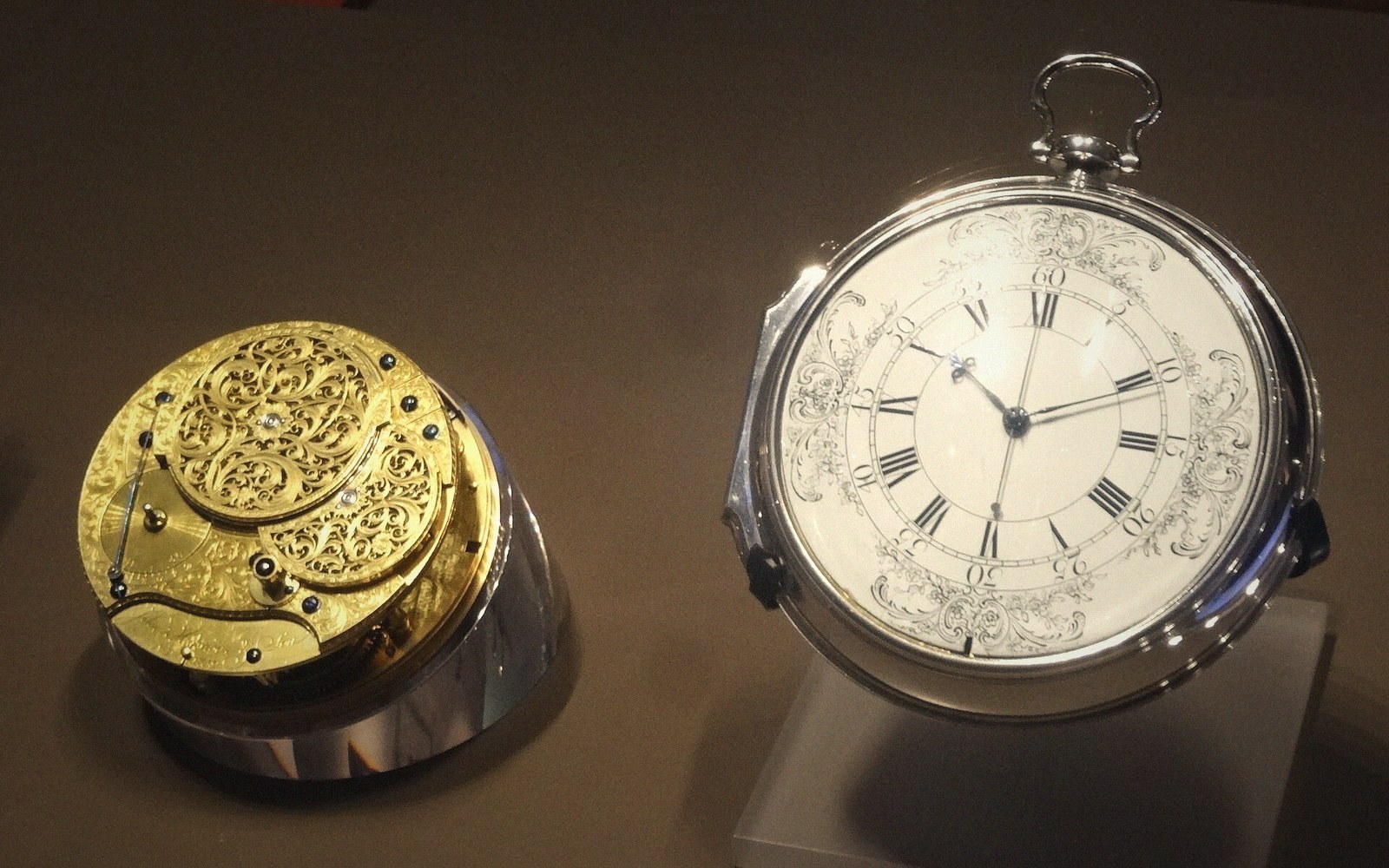
Finished in 1759 and now at the Royal Observatory, a large watch that kept time well enough to find longitude across an Atlantic crossing.
01A Watch That Solved a Century-Old Problem
The object that ended the longitude problem looks, at first glance, like a very large pocket watch. It is about five inches across, silver-cased, and could sit comfortably in a waistcoat pocket if the pocket belonged to someone unusually broad-chested. Nothing about its appearance announces that it defeated a problem governments had spent a century trying to crack — that navigators were dying by the thousands because nobody could reliably tell a ship where it stood on the east-west axis of the globe. Yet H4, completed by John Harrison in 1759 and now held at the Royal Observatory Greenwich, is the instrument that closed the argument. It did so not by being the cleverest clock ever made but by being right, demonstrably and repeatedly, in conditions that had broken every previous attempt.
Harrison had spent the preceding decades building his case in wood and brass. H1, H2 and H3 were large, inventive, increasingly refined marine timekeepers, each attacking the problem of keeping a stable rate aboard a rolling ship in varying temperatures. The sea is merciless to a clock: it tilts the mechanism, damps the air, corrodes the pivots, and swings the temperature between the tropics and the North Atlantic within a single voyage. Harrison's first three machines used interconnected balance wheels, grasshopper escapements and gridiron temperature compensation to fight those forces. They were extraordinary. They were also large, complicated, and not easily replicated. Around 1753, while H3 was still being finished, Harrison quietly began something different.
H4 abandoned the pendulum logic entirely and committed to a watch movement scaled up rather than a clock scaled down. At its heart is a fast-beating balance — vibrating at five times per second, or 18,000 beats per hour — which gave it a stability that slower balances simply could not match. A faster oscillator is less disturbed by any individual impulse from the escapement and less sensitive to the ship's motion. Harrison borrowed and refined a form of verge escapement, paired it with a precisely cut and poised balance, and equipped it with a remontoire — a small auxiliary spring wound every seven and a half seconds from the main spring — so the force delivered to the escapement stayed constant regardless of how the mainspring ran down. Temperature compensation was achieved through a bimetallic curb on the balance spring: as the spring softened in heat, the curb's two metals bent to alter its effective length, keeping the rate steady. Every one of these ideas had precursors; the genius of H4 was their integration into something that actually worked at sea.
02The Trial That Mattered
The Board of Longitude had been offering its famous prize since 1714, but collecting it required proof by trial: a voyage to the West Indies, with the error in longitude determined at the end. In November 1761, H4 sailed for Jamaica aboard HMS Deptford, accompanied by Harrison's son William rather than Harrison himself, who was then sixty-eight. When the ship made landfall at Madeira, William used H4 to predict the island's longitude before the captain confirmed it by lunar observation. The watch was right. By the time Deptford reached Jamaica after ten weeks at sea, H4 had accumulated an error of less than two minutes of time — translating to under thirty-five miles of longitude, well inside the prize threshold of thirty miles.
The Board did not immediately pay. Nevil Maskelyne, the Astronomer Royal from 1765, was a committed advocate of the competing lunar-distance method and conducted a second trial himself. His handling of H4 during that trial and his subsequent rating of its performance became a source of bitter dispute; Harrison believed the watch had been deliberately disadvantaged. A third trial in 1764 returned a result even better than the first. The longitude error after the outward voyage to Barbados was just over ten miles. By any reading of the original prize criteria, Harrison had won. Parliament eventually recognised this in 1773 and paid him a further sum that brought his total receipts close to the prize value, though he never formally received the prize itself. Harrison was then eighty and had three years left to live; he died in 1776 at his home in London, having spent more than forty years on the problem.
03What the Watch Required to Teach
The Board's reluctance was not pure obstruction. One of its conditions was that the method be reproducible — that any competent watchmaker could be taught to build an instrument that performed similarly. A single miraculous object proved nothing about a navigational system. Harrison resisted handing over H4 for examination, understandably suspicious after Maskelyne's trial, but eventually a copy was made under controlled conditions. The maker was Larcum Kendall, and his copy, designated K1, was completed in 1769.
It went around the world with James Cook on his second Pacific voyage beginning in 1772, and Cook's logs record his admiration for it in terms that amount to professional astonishment.
I · Longitude · Harrison's H4
K1 demonstrated the method but not the economics. Kendall had taken two and a half years and was paid five hundred pounds, which was the cost of a small ship. The practical breakthrough that turned the marine chronometer from a curiosity into a navigational tool came from John Arnold and Thomas Earnshaw, who through the 1770s and 1780s worked out how to simplify, standardise and produce the key elements — particularly the detent escapement and the helical balance spring — so that chronometers could be made in quantity at prices working ships could afford. They are the people who made Harrison's solution a system rather than a specimen.
H4 itself was examined, rated and eventually handed to the Board, where it remained before passing into the collection that became the National Maritime Museum. It can be seen today at the Royal Observatory, still in its original silver pair-cases, alongside H1, H2 and H3 in a display that makes the whole forty-year sequence visible at once. The four machines together tell the story better than any account can: the great wooden balancing clocks, each one a dead end refined, and then the watch — compact, jewelled, almost frivolous in appearance against its predecessors, and correct.
What H4 solved, precisely, was not horological but epistemological. The Board of Longitude and the scientific establishment needed to believe that a mechanical oscillator, not an astronomical calculation, could be trusted to carry time reliably across an ocean. Harrison spent his life making that case, and H4 made it irrefutably. The watch is not the most accurate timekeeper the world has ever seen; Shortt's free pendulum and the quartz oscillators that followed it left H4's performance far behind. But accuracy exists on a scale, and in 1761 this watch was accurate enough — accurate enough to find Jamaica, to find Barbados, to find the longitude, and to change what navigators could know about where they stood on the surface of the earth.
Chronology
In order
- 1714Board of Longitude established; prize announced
- c. 1753Harrison begins work on H4 alongside H3
- 1759H4 completed
- 1761First sea trial, HMS Deptford to Jamaica; William Harrison accompanies the watch
- 1764Third sea trial to Barbados; error just over ten miles
- 1765Nevil Maskelyne appointed Astronomer Royal
- 1769Larcum Kendall's copy K1 completed
- 1772K1 sails with James Cook's second Pacific voyage
- 1773Parliament pays Harrison a further sum bringing his total near prize value
- 1776Harrison dies in London