The Sea Defeats a Clock
A pendulum needs gravity to work. A ship gives it everything else.
01Why the Land Clock Fails at Sea
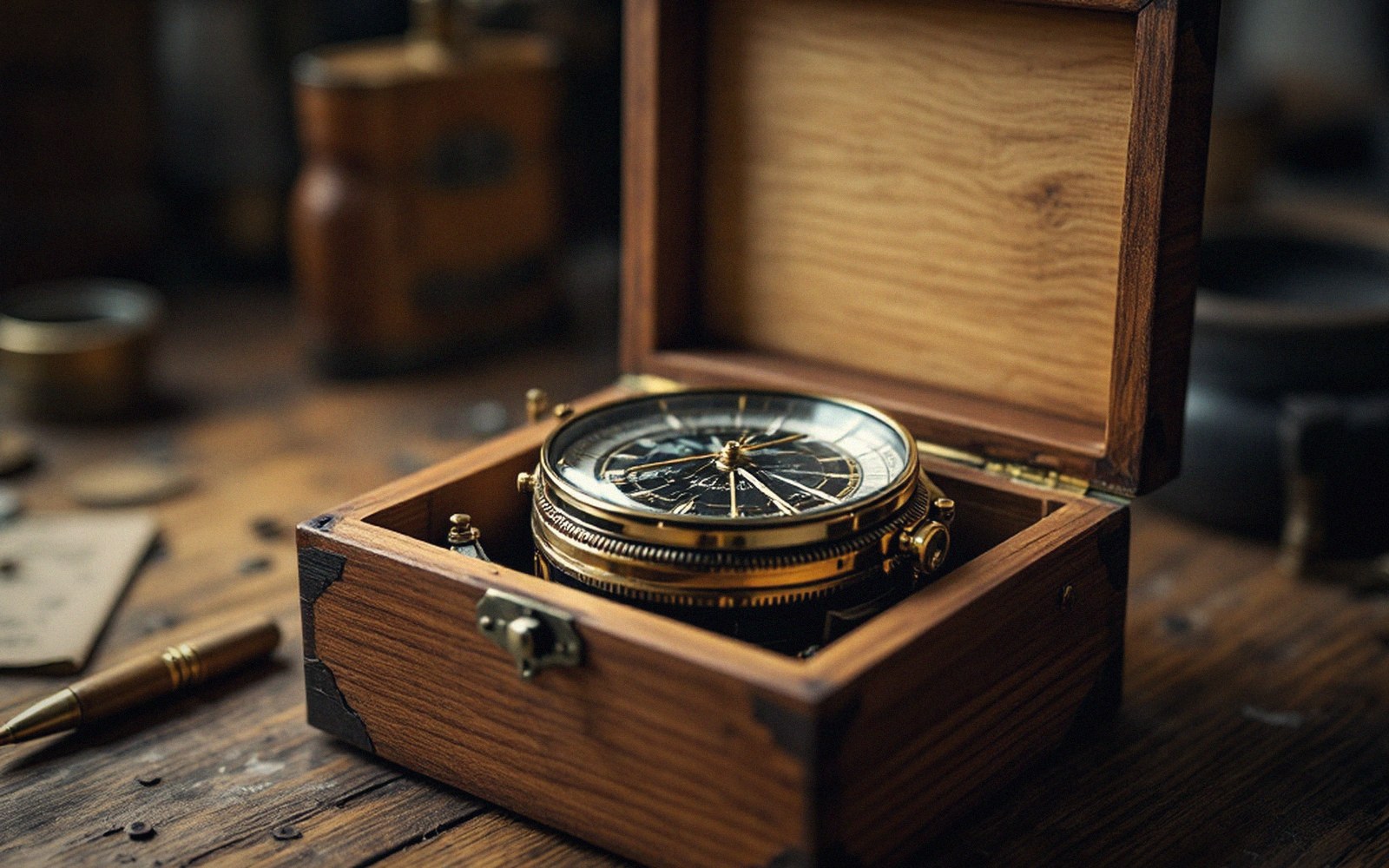
A precision clock of the early eighteenth century was a finely argued object. Its pendulum swung in a fixed vertical plane, its pivots ran in jewelled or polished brass bearings aligned by a careful hand, and its rate was adjusted on the assumption that temperature, humidity and orientation would change slowly if at all. Move it aboard a ship and every one of those assumptions collapses within the first watch.
The pendulum is the first casualty. It keeps time because gravity pulls it back to centre with a force proportional to its displacement — but only while the pivot point is still. A ship rolls, and the effective gravity vector swings with the hull. The pendulum no longer swings in a fixed plane; it compounds its own motion with the vessel's, and the result is a rate that wanders unpredictably. In a heavy sea the bob may swing athwartships and forward simultaneously, tracing chaotic arcs that bear no useful relationship to a second. George Graham understood this clearly when he helped John Harrison think through the problem in London in 1730. Harrison's answer, pursued across four decades, was to abandon the pendulum entirely in favour of a balance — a rotating oscillator that does not care which way is down.
02Salt, Damp, and Temperature
Even without the motion problem, the sea's atmosphere attacks a clock's materials. Salt air is hygroscopic and corrosive: it swells wooden plates, rusts ferrous components, and leaves a conductive film on brass surfaces that can make pivot holes behave unpredictably. The lubricating oils available in Harrison's era — whale or olive — changed viscosity sharply with temperature, gumming in the cold of the North Atlantic and thinning dangerously in the tropics. An escapement adjusted to run sweetly in a London workshop would be fighting its own lubricant by the time the ship crossed the Bay of Biscay.
Temperature also acts directly on metal. A steel balance spring stiffens as it cools, making the oscillator swing faster; it softens in warmth and slows the clock down. A voyage from Portsmouth to Jamaica spans something like thirty degrees of ambient temperature, enough to shift an uncorrected chronometer's rate by several seconds per day — which, converted back to longitude, means miles of positional error by landfall. John Arnold and Thomas Earnshaw each spent careers learning to compensate the balance with bimetallic rims and carefully selected spring alloys, driving the error down to levels the Board of Longitude had once considered impossible. Their insight was that compensation had to be built into the oscillator itself, not applied from outside — the sea was simply too variable for any correction made at the bench to survive the voyage intact.
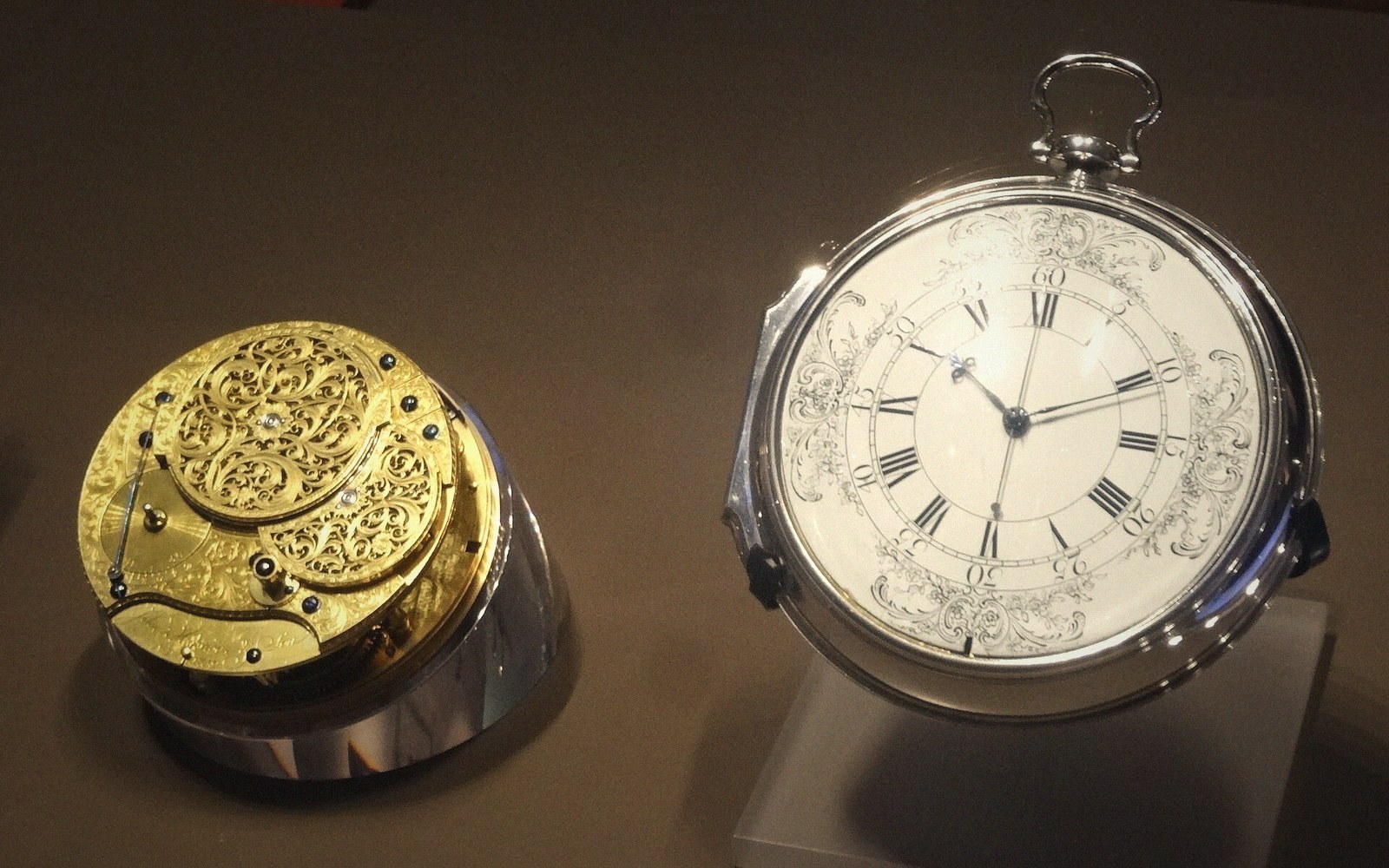
Harrison's own solution to the oil problem was characteristically oblique: his grasshopper escapement was designed to run with almost no sliding contact between its parts, so that lubrication was barely needed at all. It is one of the reasons his earlier clocks, H1 through H3, continued to run for years without intervention — a quality a marine instrument needed above almost any other. His final answer, H4, used a conventional verge-like action but paired it with a remontoire, a small secondary spring that re-wound every few seconds and insulated the balance from the jerks and variations in the going train caused by the ship's motion. The result, tested on a voyage to Jamaica in 1761–62, was startling accuracy.
What the sea ultimately demanded was not a better room clock but a different kind of instrument — one that replaced the pendulum with a contained oscillator, replaced sliding-contact escapements with lower-friction alternatives, built thermal compensation into its own moving parts, and assumed from the outset that it would be tipped, soaked, chilled, heated and shaken every hour of its working life. Solving each of those problems in sequence is the history of the marine chronometer.
Chronology
In order
- 1730Harrison meets George Graham in London; pendulum's sea problem acknowledged
- 1730s–1750sH1, H2, H3 developed; grasshopper escapement avoids oil dependency
- 1759H4 completed, using a remontoire to isolate the balance from train disturbances
- 1761–62H4's Jamaica trial demonstrates that a portable timekeeper can solve the longitude problem
- Late 18th c.Arnold and Earnshaw industrialise compensation, making the marine chronometer reproducible
Read next in I · Longitude
3 entries in this section · section page- I · LongitudeHarrison's H4Finished in 1759 and now at the Royal Observatory, a large watch that kept time well enough to find longitude across an Atlantic crossing.Read the entry →
- I · LongitudeWhy longitude is timeThe Earth turns fifteen degrees an hour, so knowing the time at a reference place tells you how far around you are.Read the entry →