Arnold and Earnshaw
From bespoke miracle to working tool: how two London makers turned the marine chronometer into something a ship could actually carry.
01The Problem with a Single Masterpiece
When Harrison's H4 passed its sea trial in 1764, it proved that a portable timekeeper could solve the longitude problem. What it did not prove was that anyone else could make one. H4 was the product of decades of singular obsession — a horological argument in metal rather than a manufacturable instrument. The Board of Longitude understood the gap between "this works" and "a thousand ships can have one," and so did the generation of London makers who came after Harrison. Of those, two matter most: John Arnold and Thomas Earnshaw.
They were not collaborators. They disputed priority fiercely, corresponded with mutual hostility, and each believed the other had stolen the essential idea. History has largely refused to adjudicate, and that is the right instinct — because both men solved the same cluster of problems by converging on similar answers from different directions, and the chronometer that emerged was shaped by the pressure of both.
02What Had to Be Reinvented
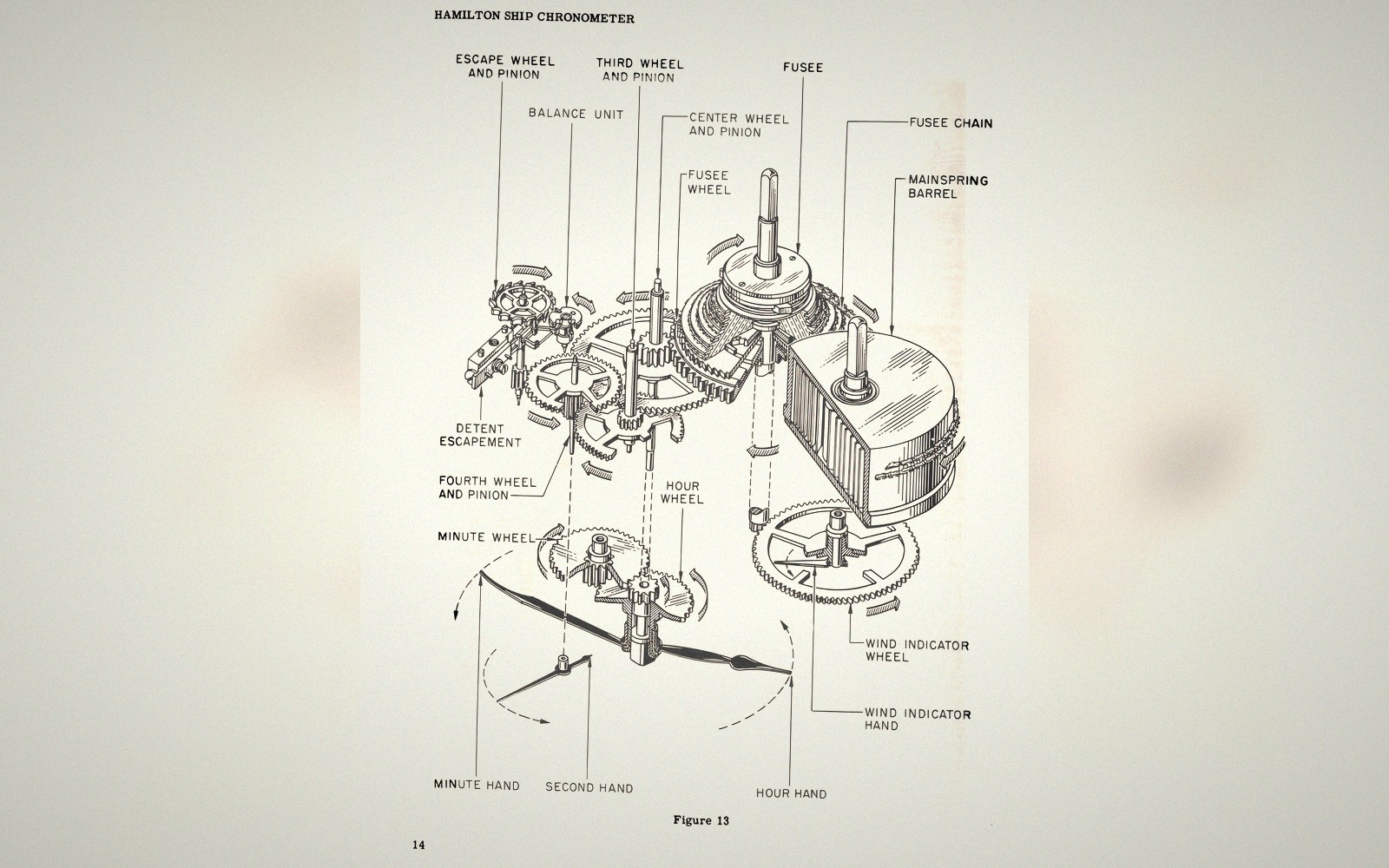
Harrison's solution to the sea was brilliant and idiosyncratic. His temperature compensation, his grasshopper escapement, his remontoire — each was a custom answer to a specific problem, and none transferred easily to a workshop making instruments in quantity. Three things had to be redesigned from first principles before a chronometer could be produced reliably: the escapement, the balance and the means of compensating for temperature.
The escapement was the most urgent. The verge that had served pocket watches for centuries was far too sensitive to positional error. George Graham's cylinder was better but still inadequate for a rolling deck. What was needed was a detent — a mechanism that released the train with the lightest possible touch and gave nothing back to the balance except the single impulse needed to keep it swinging. A detent escapement nearly eliminates the interference between going train and oscillator, which is why it could achieve the isochronism — equal timing regardless of arc — that a marine timekeeper demands. Arnold developed a pivoted-detent form; Earnshaw independently arrived at a spring-detent version. The spring detent proved more robust at sea and became the standard. Both men worked in London, both were drawing on the same intellectual atmosphere, and the question of who thought of it first became a grievance neither ever let go.
The balance and its compensation presented a linked problem. A plain brass balance changes its rate with temperature because the metal's elasticity shifts — the spring stiffens in cold and slackens in heat, altering the period of oscillation. The bimetallic balance answered this: a rim cut in two places and composed of brass fused to steel, so that temperature change causes the free ends to curl inward or outward, moving mass in the direction that corrects the error. Arnold was producing compensation balances by the late 1770s. Earnshaw refined the construction and made it cheaper to produce consistently. Neither invented the principle from nothing — the idea of using differential expansion was already in the air — but they each turned a concept into a component a journeyman could fit.
Arnold also developed a helical hairspring, curving the spring into a helix rather than lying flat, which improved isochronism by allowing the coils to breathe more evenly. He worked at a scale that let him number his chronometers into the hundreds, and his instruments were tested at the Royal Observatory Greenwich — the institution that had driven the longitude problem from the start — where their rates were logged and published.
Earnshaw's contribution was as much economic as technical. He drove the price of a good chronometer down, not by cutting corners but by rationalising construction. By the time of the Napoleonic Wars, the Royal Navy could outfit multiple vessels simultaneously, which would have been inconceivable if every instrument still required the hand of a single genius.
What Arnold and Earnshaw together accomplished was a translation: from a demonstration of possibility to a means of production. The longitude problem had been solved in principle by one remarkable man in Barrow upon Humber who eventually settled in London; it was solved in practice by two contentious Londoners who trusted argument, repetition and the test of the sea to refine what the theory demanded.
Chronology
In order
- 1764H4 sea trial establishes the principle
- Late 1770sArnold producing compensation balances and helical hairsprings at scale
- By early 1800sEarnshaw's rationalised production brings chronometer costs within naval reach; multiple Royal Navy ships equipped simultaneously