The Grasshopper
The escapement that taught itself to run without oil — and why that mattered more than anyone first realised.
01The problem it was built to solve
Every escapement of Harrison's day ran on oil. The pallets that caught each tooth of the escape wheel pressed against metal under load, and without lubrication they would wear quickly and run rough. But oil was the enemy of long-term accuracy: it thickened in the cold, thinned in the heat, gummed with age, and changed the friction on the pendulum's arc unpredictably. A clock that needed oiling needed re-rating afterward. For a precision timekeeper — one meant to sit at a longitude-measuring observatory or survive years at sea — this was an unresolved contradiction at the heart of the machine.
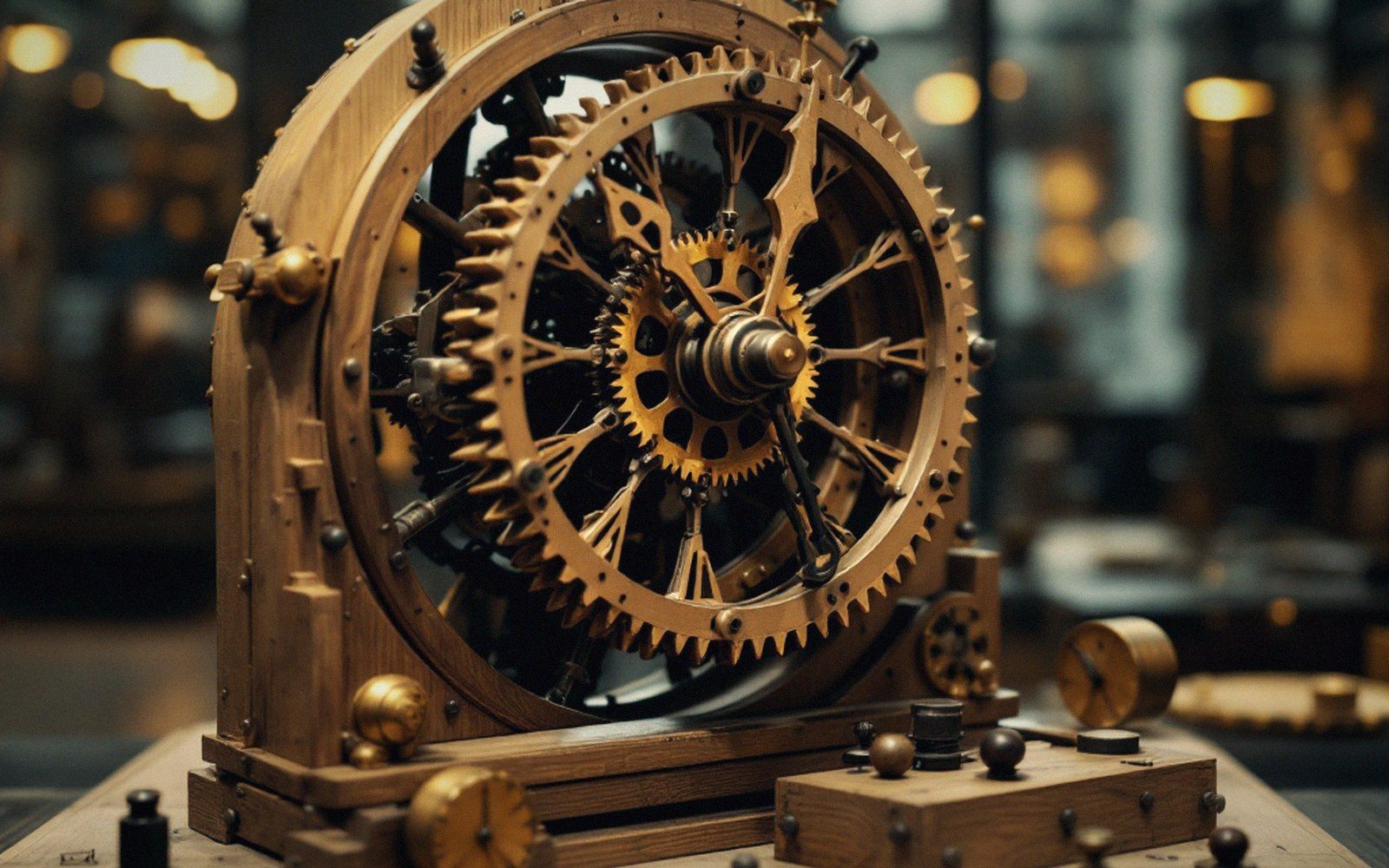
John Harrison's answer, developed in the first decades of the eighteenth century and used in his large wooden-framed precision clocks, was the grasshopper escapement. Its genius was mechanical rather than material: the pallets, made from lignum vitae (an exceptionally hard, self-lubricating wood), rocked in and out of engagement on pivots rather than sliding across the escape-wheel teeth. Contact was brief, almost tangential, and the geometry was arranged so the pallet hopped clear the instant it had done its work — hence the name, from the quick, cocked-leg motion the parts make in action.
The result was an escapement that imposed almost no friction on the going train and gave almost no disturbance to the pendulum. Because it required no oil on its working surfaces, its behaviour did not drift as the lubricant aged. Harrison's two famous precision regulators — now in the collection of the Worshipful Company of Clockmakers — kept their rates with a consistency that astonished contemporaries and still impresses anyone who examines the mechanism today.
The grasshopper never became a workshop standard. It was fussy to set up, demanded tight geometric tolerances, and its advantages were most apparent only in the highest class of precision work where conventional escapements and their oil problems were most damaging. But the principle it embodied — reduce the impulse, minimise the interference, question whether lubrication is necessary at all — ran like a thread through every improvement in escapement design that followed, from George Graham's deadbeat onward to the detached lever and beyond.
Chronology
In order
- Early 18th centuryHarrison develops the grasshopper escapement for his precision floor clocks
- Harrison's large wooden regulatorsheld today by the Worshipful Company of Clockmakers
Read next in II · Escapement
4 entries in this section · section page- II · EscapementWhat an escapement doesIt releases the train one tooth at a time and returns a push to the oscillator, doing two jobs that fight each other.Read the entry →
- II · EscapementThe deadbeatGeorge Graham's escapement stopped the recoil that pushed the pendulum back and improved rate immediately.Read the entry →
 II · EscapementThe leverThomas Mudge's escapement is in almost every mechanical watch made since.Read the entry →