The Lever
The escapement that Mudge invented and almost nobody used until it was too late to thank him.
01What the lever actually does
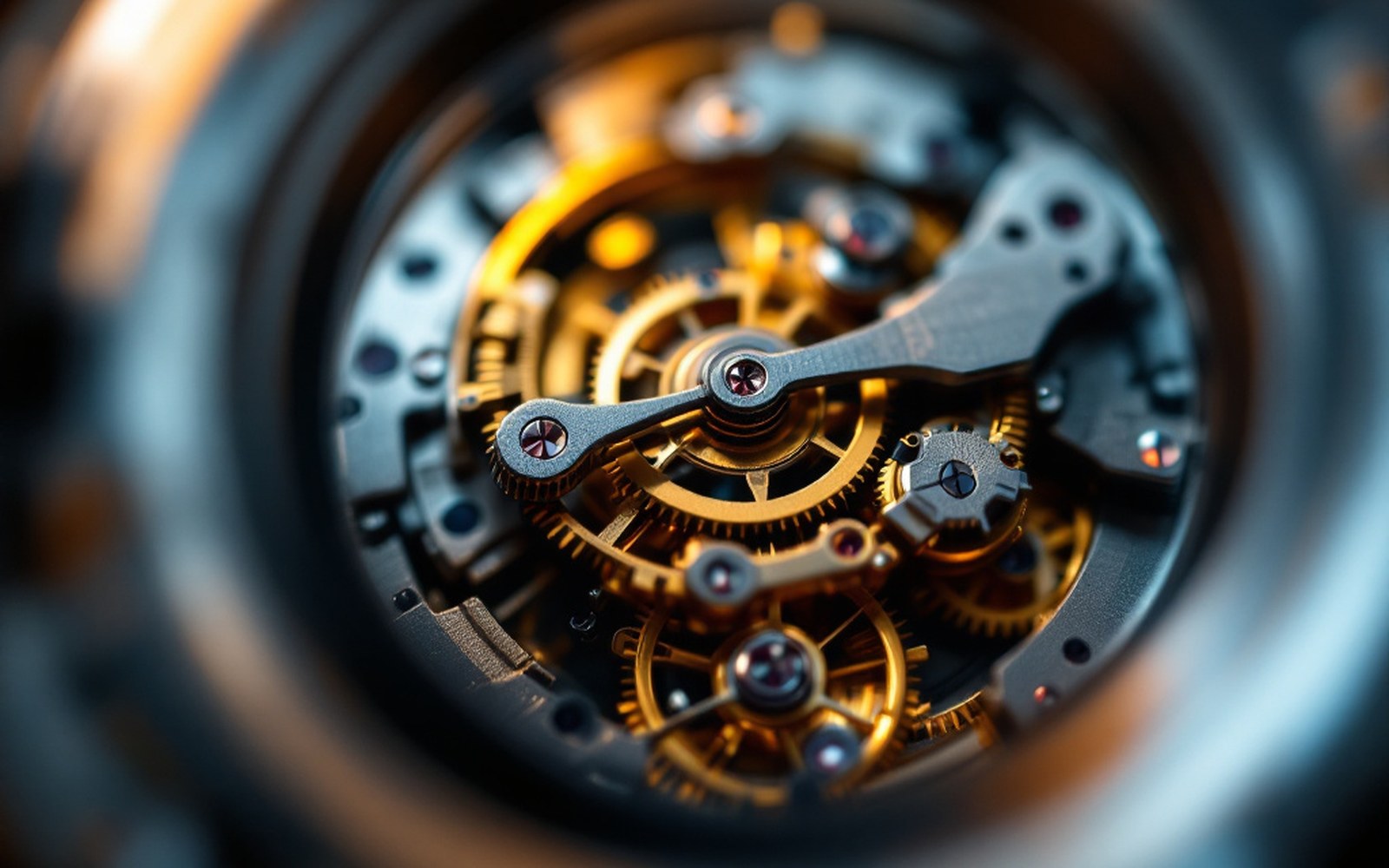
A watch needs its oscillator — the balance wheel — to swing freely, receiving just enough push to keep going without being constantly gripped by the gear train. That is what an escapement does: meter the energy, deliver the impulse, let go. Every design before Thomas Mudge's lever escapement solved this problem imperfectly, leaving the balance in contact with the train for an uncomfortable fraction of its swing. Mudge's insight was to make the contact fleeting: the balance is unlocked, pushed, and released in a small arc, then left entirely alone for the remainder of its oscillation. Engineers call that condition "detached," and it is the quality that makes the lever escapement so accurate.
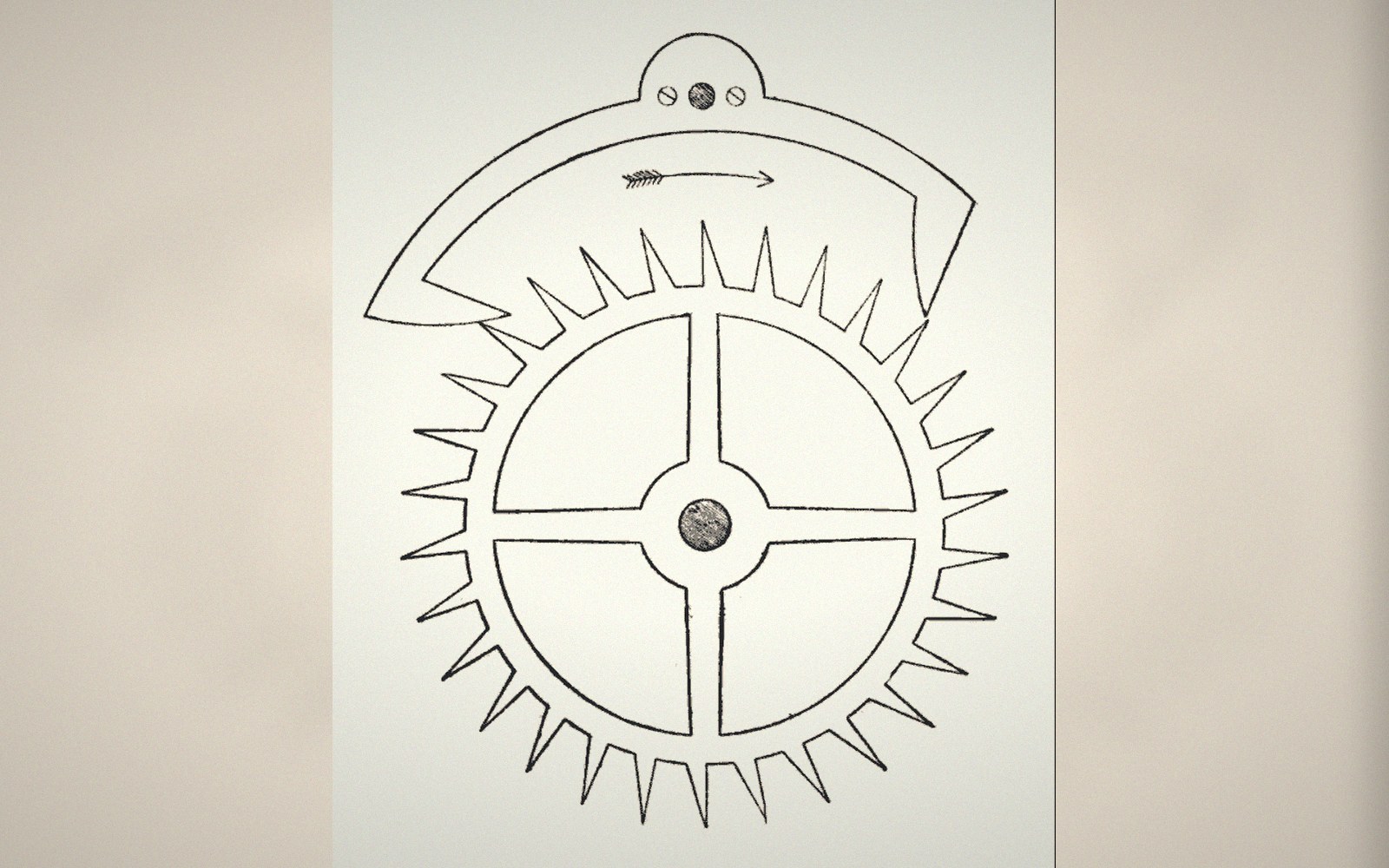
The mechanism pivots on a lever — a small rocking arm shaped roughly like a letter T — with two angled pallets at one end that engage the escape wheel, and a notch at the other that the balance's impulse pin enters and immediately exits. When the balance swings one way, the impulse pin enters the notch, the lever rocks, one pallet releases a tooth and the other catches the next, and the escape wheel turns by exactly one tooth pitch. In the same motion, the lever delivers a brief, precise push to the impulse pin. The balance then swings freely until it returns, repeating the sequence on the other side. Nothing touches the balance except during those two brief moments per swing.
02Mudge's achievement, and the long wait
Thomas Mudge finished his first lever watch in 1754 and presented it to Queen Charlotte around 1770. He does not appear to have considered it commercially promising, and he moved on to other work — notably his marine timekeepers, which occupied him for years and earned him a grant from Parliament. The lever sat largely dormant. Mudge himself worked primarily in London, trained under George Graham, and brought Graham's precision temperament to everything he built; but the lever escapement was not the one he chose to develop.
It was Swiss and English makers in the early nineteenth century who resurrected and standardised the form. The Swiss established the geometry that became universal: entry and exit pallet angles, draw — a slight angling of the pallet faces so the lever is held against its banking by the escape wheel's own pressure, preventing accidental unlocking — and the precise proportions of the notch and pin. "Draw" is the feature that makes the lever safe: a shock that knocks the balance cannot easily trip the lever into releasing a tooth out of sequence. That safety, combined with the escapement's detached action and its tolerance for imperfect lubrication, made it manufacturable. By the mid-nineteenth century it was the movement of choice for quality pocket watches; by the twentieth, it was inside nearly every mechanical wristwatch produced anywhere in the world.
The lever escapement's nearest rival for marine timekeeping, the detent escapement developed by John Arnold and Thomas Earnshaw, is more accurate in steady conditions but dangerously sensitive to shock — a stumble or a knock can set it tripping freely. On a wrist, that would be catastrophic. The lever's draw mechanism gives it robustness the detent cannot match, which is why the detent stayed at sea while the lever went everywhere else.
Mudge's original watch survives in a historic collection. The geometry he established is still being produced, by the hundreds of millions, in movements that his eighteenth-century tools could not have imagined building.
He solved the fundamental problem — free the balance, make the impulse brief, make accidental release impossible — and the solution turned out to be so good that nobody has replaced it.
II · Escapement · The Lever
Chronology
In order
- 1754Mudge completes his first lever watch in London
- c. 1770watch presented to Queen Charlotte
- Early 19th centurySwiss and English makers standardise the lever geometry for production
- Mid-19th centurylever dominant in quality pocket watches
- 20th centurystandard escapement in virtually all mechanical wristwatches worldwide
Read next in II · Escapement
4 entries in this section · section page- II · EscapementWhat an escapement doesIt releases the train one tooth at a time and returns a push to the oscillator, doing two jobs that fight each other.Read the entry →
- II · EscapementThe deadbeatGeorge Graham's escapement stopped the recoil that pushed the pendulum back and improved rate immediately.Read the entry →
 II · EscapementThe grasshopperHarrison's near-frictionless escapement needed no oil, which is why his clocks kept running.Read the entry →