What an Escapement Does
The mechanism that holds the clock back also keeps it going — and that contradiction is the whole problem.
01The Two Jobs
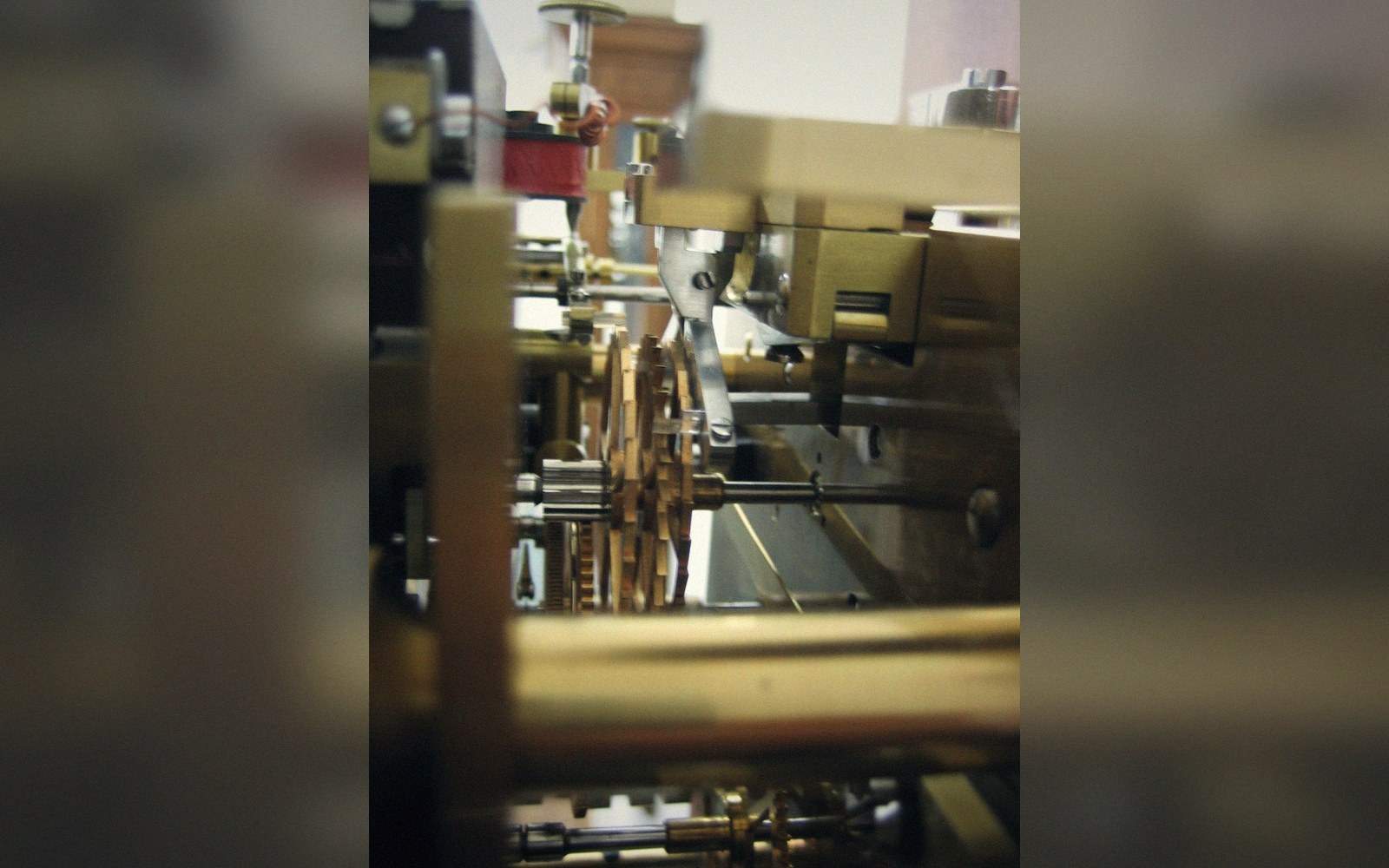
A clock is, at its core, a controlled fall. Hang a weight or coil a spring, and energy wants to release all at once. Left to itself, a gear train will spin down in seconds. The escapement is the brake — the one component in the going train that rations the energy out, one tooth at a time, at a rate governed by something that swings.
That swinging thing is the oscillator: a pendulum in a clock, a balance wheel in a watch. The oscillator is the timekeeper. It has its own natural frequency, wants to swing at its own pace, and would do so very happily if nothing interfered with it. The escapement's first job is to count its swings — releasing a tooth of the escape wheel each time the oscillator passes through a given point, and holding the train locked between those releases. This is why the familiar tick-tock exists: not a sound of machinery working, but a sound of machinery being stopped, twice per beat, over and over again.
The second job is the opposite of the first. The oscillator loses energy to air resistance and friction. Without a periodic push, it would swing with diminishing amplitude until it stopped, and the clock would stop with it. So the escapement must also return some of the train's energy back to the oscillator, nudging it at precisely the right moment to sustain the swing. It is a gate and a pump simultaneously. Both tasks must be performed by the same small mechanism, and they fight each other — because every moment the escapement is in contact with the oscillator to give it a push, it is also disturbing the very motion it is trying to preserve.
02The Geometry of Interference
The recoil anchor escapement, already widespread in English clocks by the late seventeenth century, did both jobs clumsily. Its pallets — the rocking surfaces that lock and release the escape wheel — engaged the wheel teeth in a way that allowed the wheel to push backward slightly as the pendulum swung through. The pendulum was being pushed away from its natural arc twice per beat. That intrusion into the oscillator's freedom is a rate error, and it is not stable: as the mainspring runs down and the drive force changes, the amount of push changes with it, so the rate drifts.
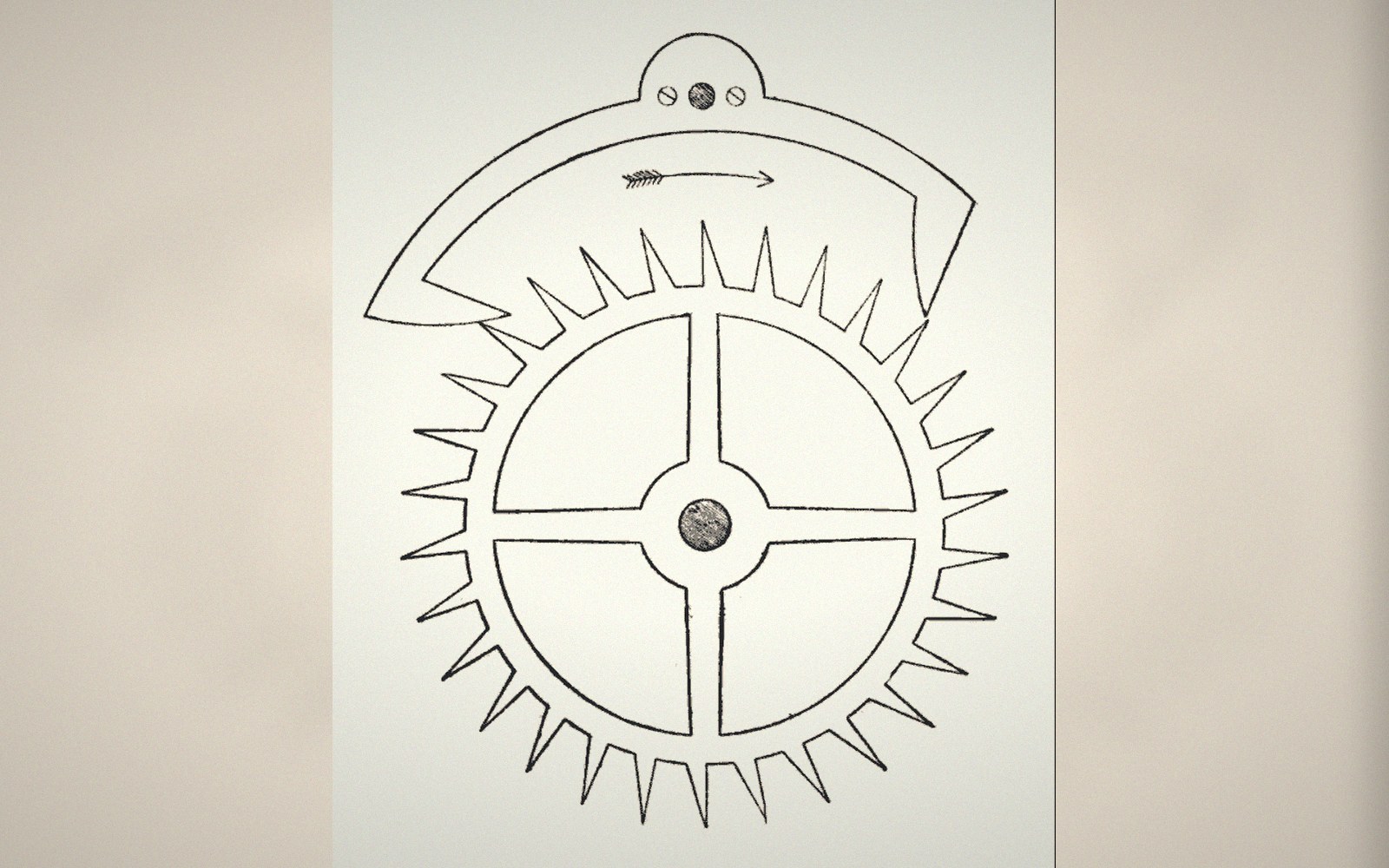
George Graham's deadbeat escapement, introduced in the 1720s, addressed this directly. By reshaping the pallets so that the holding surface was concentric with the pallet's own pivot, Graham eliminated the backward push — the recoil — during the locked phase. The escape wheel tooth rested on a curved face that held it still, rather than shoving the pendulum back. The impulse was still given, briefly, as the tooth slid onto the angled impulse face before releasing, but the period of lock was genuinely dead: no recoil, no disturbance. George Graham's escapement became the standard for precision pendulum clocks, and the observatory regulators at Greenwich used it for a century.
The problem that deadbeat geometry solved for pendulums was solved differently for the portable timekeeper. Thomas Mudge's lever escapement, developed in the 1750s, used a detent-like lever between the escape wheel and the balance wheel so that the balance was free — fully detached from the train — for most of each oscillation, receiving a push only briefly at the dead centre of each swing. This detachment principle, giving the oscillator its freedom for the longest possible fraction of the cycle, became the central preoccupation of escapement design.
John Arnold and Thomas Earnshaw independently arrived at the spring detent escapement, which takes detachment further still: the balance is free for the entire arc except a single brief engagement at the moment of impulse. The detent escapement gives a clean, minimal push, and it requires so little to maintain oscillation that it became the movement of choice inside the marine chronometer — the box that would eventually answer the longitude problem. At sea, however, its vulnerability to shock meant that a disturbed ship could trip the detent and stop the watch cold, a failure the lever escapement resists far better.
03Isochronism and the Ideal Oscillator
Releasing a tooth and giving a push are the escapement's mechanical jobs, but they serve a theoretical ideal: isochronism, the property of swinging in equal time regardless of amplitude. A truly isochronous oscillator needs no push at all to keep time correctly — the same arc would take the same duration whether the swing was wide or narrow. No real oscillator is perfectly isochronous. A pendulum following a circular arc swings very slightly faster when its arc is smaller; a balance wheel has its own amplitude-dependent errors. What the escapement designer wants is an impulse so light and so consistent that amplitude stays nearly constant, because any variation in amplitude becomes a variation in rate.

This is why the size of the push matters as much as its timing. An escapement that pushes too hard will force the oscillator to swing wider than its ideal arc; one that pushes irregularly — because, for instance, mainspring force is higher at the start of a run-down than at the end — will cause the amplitude to vary across the day. The fusee, a conical pulley that evens out spring tension across the full run, exists largely to feed the escapement a consistent impulse. Temperature compensation in the balance wheel exists largely to keep the oscillator's own timing stable despite the material changes the metal undergoes. Every subsidiary device in the movement is, in some sense, serving the escapement's impossible double mandate.
04What Was Never Fully Solved
No escapement is truly transparent to the oscillator it governs. Every design imposes some interference — some disturbance to the free swing — and every designer since Graham has been managing the size, timing and symmetry of that disturbance rather than eliminating it. William Hamilton Shortt's free pendulum system of the 1920s came closest to the ideal: a master pendulum swinging in a near-vacuum received its impulse only once every thirty seconds, from a mechanically separate slave clock, making the interference so brief and infrequent that the master's rate became almost independent of it.
The quartz resonator, developed commercially in the following decades, sidesteps the escapement entirely. An electronic oscillator sustains the crystal's vibration without physical contact, and the counting is done electronically. The centuries of geometric ingenuity that produced deadbeat pallets, spring detents, and lever safety-actions became unnecessary in an afternoon. What replaced them solved the fundamental problem — keeping the oscillator free while keeping it going — by abandoning mechanics altogether, which is perhaps the most honest acknowledgment that the escapement's two jobs were always, at some level, irreconcilable.
Read next in II · Escapement
4 entries in this section · section page- II · EscapementThe deadbeatGeorge Graham's escapement stopped the recoil that pushed the pendulum back and improved rate immediately.Read the entry →
- II · EscapementThe leverThomas Mudge's escapement is in almost every mechanical watch made since.Read the entry →
 II · EscapementThe grasshopperHarrison's near-frictionless escapement needed no oil, which is why his clocks kept running.Read the entry →