The Deadbeat
Graham's fix was elegant and simple: let the tooth rest, don't let it push back.
01The fault it was built to fix
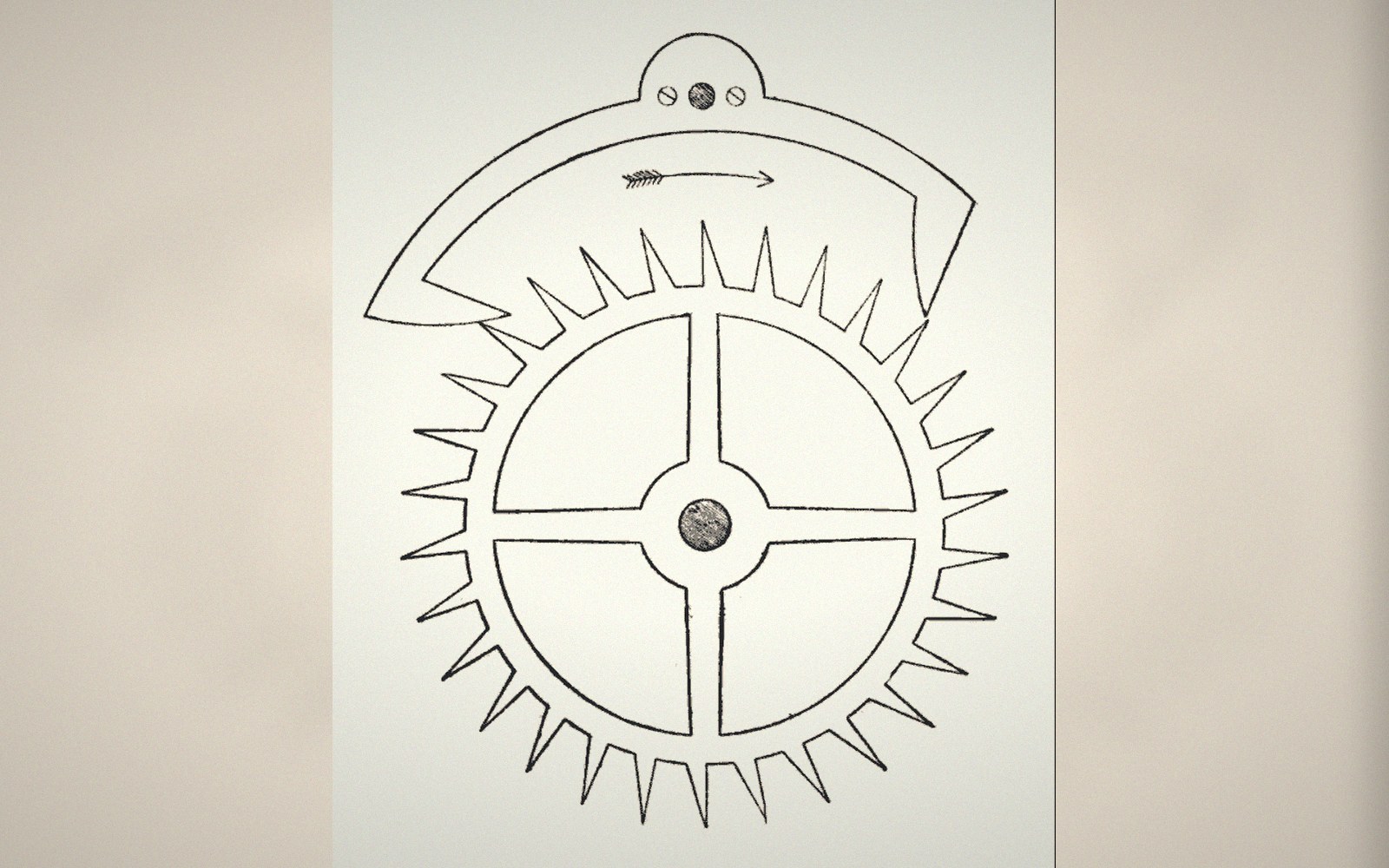
Every pendulum clock before George Graham's refinement of the 1720s suffered the same nagging error. The recoil escapement — the dominant design of the previous half-century — did exactly what its name suggests: at the end of each swing, the escape wheel did not simply stop. It pushed back. The geometry of the pallets meant that as the pendulum reached the limit of its arc, the tooth bearing against the locking face actually drove the wheel backward a fraction of a tooth. That brief reversal, repeated at every beat, shook the pendulum during the most delicate part of its motion, disturbed the arc, and corrupted the rate. A good recoil clock was a compromise between letting the escapement drive the pendulum and letting the escapement spoil it.
Graham understood the flaw as a mechanical argument. The pendulum wanted to swing freely; the escapement wanted to stay engaged. The recoil arrangement tried to serve both masters and satisfied neither. His answer was to separate the two phases of the escapement's job more cleanly. What an escapement does is always those two things — hold the train and return energy to the oscillator — but how they are timed against each other decides whether the pendulum is helped or harassed.
02What Graham changed
The deadbeat escapement, named for what it eliminated, uses two distinct faces on each pallet. The locking face is curved about the pivot of the pallet arbor as its centre. This geometry is the critical invention: because the locking face is a true arc centred on the arbor, the tooth rests against it without exerting any tangential force during the pendulum's swing. The wheel cannot drive the pallets forward, and it cannot be pushed backward. The tooth simply sits there, inert, while the pendulum completes its arc. No recoil. No interference.
Only when the pendulum returns through the centre of its swing does the geometry change. The tooth leaves the curved locking face and meets the angled impulse face, which is straight rather than curved. Here the escape wheel does its work, giving the pendulum a brief, clean push before the opposite pallet drops into its own locking position and the cycle repeats. The two phases — rest and impulse — are now sharply distinguished, and the pendulum swings for most of its period in undisturbed quiet.
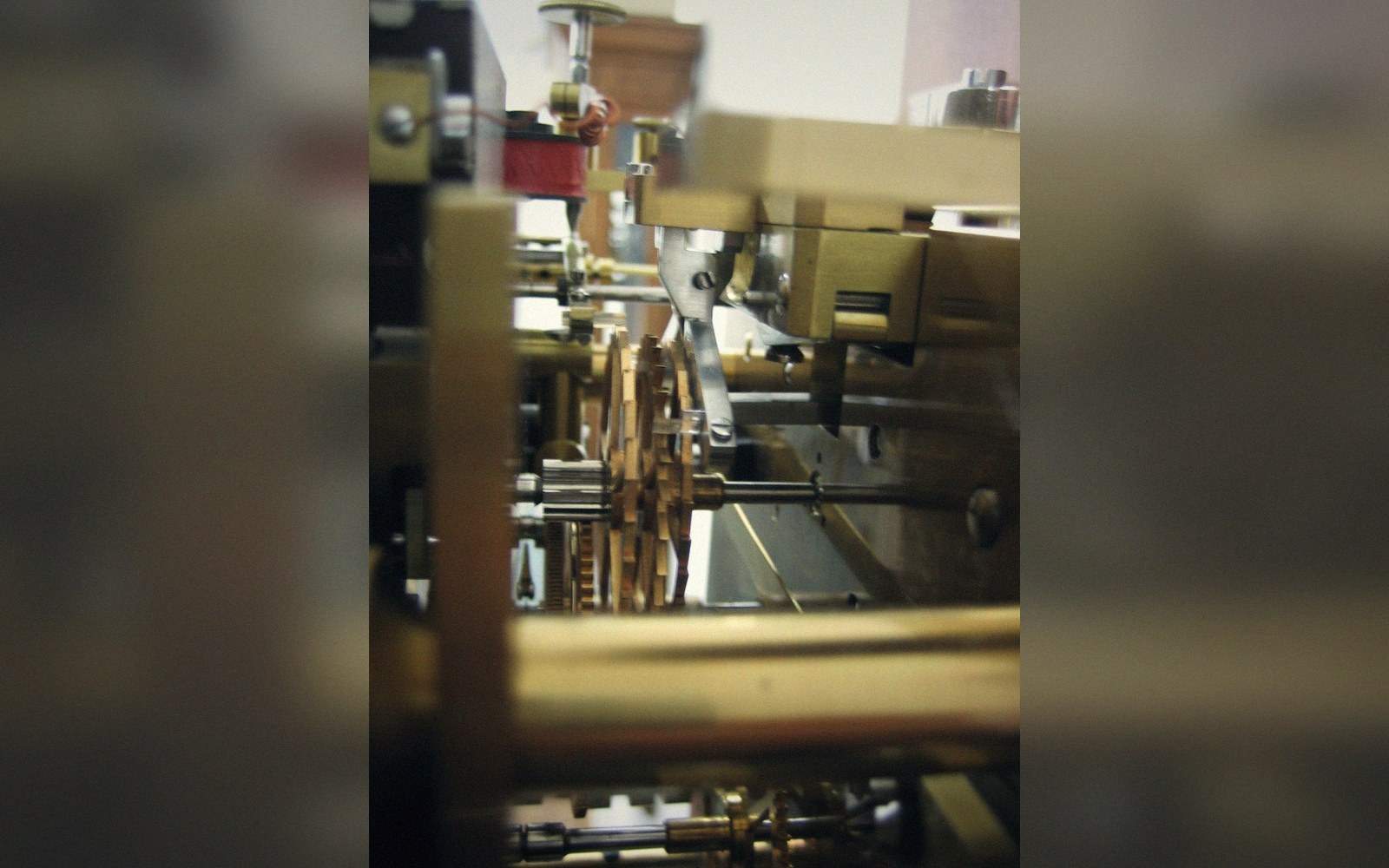
Graham, already established in London and later master of the Worshipful Company of Clockmakers, built the deadbeat into his precision regulators from the 1720s onward. George Graham was not an obscure craftsman: he had trained under Thomas Tompion, inherited Tompion's Fleet Street workshop, and was already respected enough that John Harrison sought his advice and his money when planning what would become the longitude clocks. That endorsement carries weight — Harrison was not a man to consult someone whose judgment he doubted.
The rate improvement was immediate and measurable. Royal Observatory Greenwich adopted the deadbeat as the standard escapement for its regulators, the clocks against which all others were checked. Versions of it still appear in quality pendulum clocks made today.
An escapement good enough for Greenwich was good enough for any serious horological purpose, and the deadbeat held that position for the better part of two centuries.
II · Escapement · The Deadbeat
03What it could not cure
The deadbeat's weakness is the very stillness it achieves. Because the locking face exerts no force, it also offers no self-correction for small disturbances; the pendulum that strays stays strayed until the impulse face nudges it back into rhythm. More practically, the locking faces wear. Unlike the recoil, where motion is constant and oil distributes itself, the deadbeat holds a tooth stationary against a small area of the pallet — the same spot, every beat, indefinitely. Graham used hardened steel; later makers tried sapphire. Neither material made friction disappear, only slowed the ruin.
The bigger limits of the deadbeat had nothing to do with its geometry. Temperature changed the pendulum's length; barometric pressure changed the air's resistance; the gridiron and later invar existed to answer the first problem, but the escapement itself could not help. What the deadbeat gave the clockmaker was a stable foundation — a going train that would not shake its own regulator apart — and that was already more than the recoil had managed.
Chronology
In order
- c. 1715–1720Graham develops and refines the deadbeat at his Fleet Street workshop, London
- 1720s onwardRoyal Observatory Greenwich adopts it as the regulator standard
- Ongoingdeadbeat geometry remains in use in quality pendulum clocks to the present day
Read next in II · Escapement
4 entries in this section · section page- II · EscapementWhat an escapement doesIt releases the train one tooth at a time and returns a push to the oscillator, doing two jobs that fight each other.Read the entry →
- II · EscapementThe leverThomas Mudge's escapement is in almost every mechanical watch made since.Read the entry →
 II · EscapementThe grasshopperHarrison's near-frictionless escapement needed no oil, which is why his clocks kept running.Read the entry →