The Gridiron
Nine rods, two metals, one constraint: keep the pendulum the same length regardless of what the thermometer does.
01The Problem a Pendulum Has With Heat
A pendulum clock keeps time because the pendulum's period depends on its length — specifically, on the square root of that length divided by the gravitational acceleration. Change the length by even a fraction of a millimetre and the rate shifts. A steel rod one metre long grows by roughly twelve micrometres for every degree Celsius of warming. That sounds trivial until you notice that a pendulum gaining a single second per day against its correct rate represents an error of one part in eighty-six thousand — and the steel expansion required to cause it is less than the thickness of a human hair. Temperature is not a gentle adversary.
George Graham addressed the problem in the 1720s with a mercury-filled bob: as the rod lengthened and dropped the bob's centre of mass, mercury expanding in a cylindrical jar raised it back. Elegant, but complicated to balance correctly. John Harrison, working independently in Barrow upon Humber before he ever came to London's attention, took a different approach. He built it into the rod itself.
02Nine Rods, Two Metals
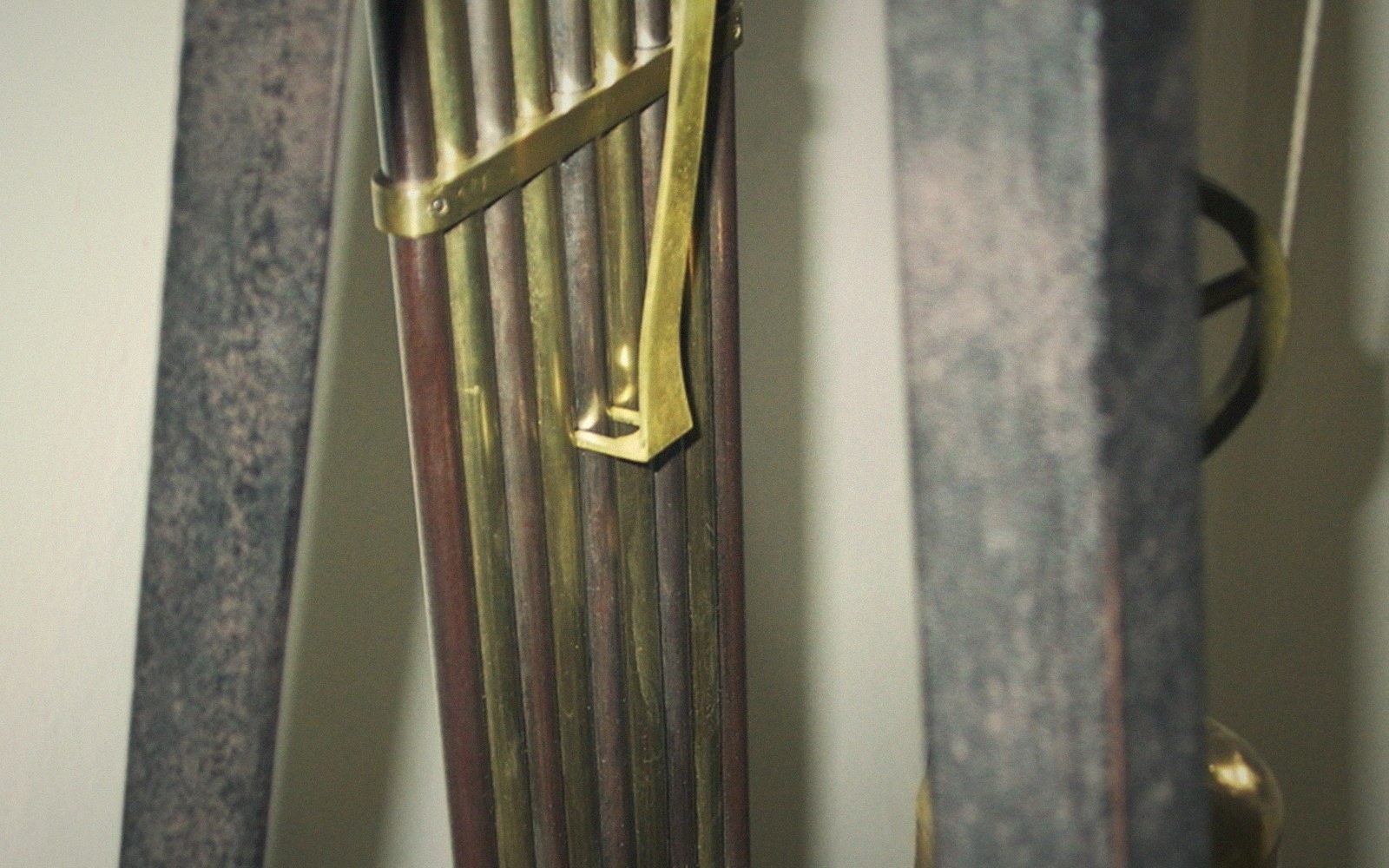
The gridiron — Harrison's name, from its visual resemblance to a cooking grill — uses brass and steel together, playing their different expansion rates against each other. Brass expands roughly fifty percent faster than steel for the same temperature rise. Harrison arranged the rods in a frame: the steel rods drive the bob downward as they lengthen (expanding in the direction that matters), while the shorter brass rods, anchored at the opposite end, push it upward. Choose the right number and length of rods in each metal, and the two motions cancel. The pendulum's effective length stays fixed.
The standard configuration uses nine rods — five steel, four brass — though the actual count matters less than the ratio of material lengths. What Harrison worked out, empirically and through careful measurement, was that the brass contribution had to equal the steel contribution exactly. If the ratio is correct, a twenty-degree swing in ambient temperature produces no measurable change in the pendulum's period. The clock's rate holds.
The Worshipful Company of Clockmakers preserves examples of Harrison's compensated pendulums, and the principle can be verified today against known coefficients of thermal expansion: steel at roughly eleven to twelve parts per million per degree Celsius, brass at around nineteen to twenty. The math closes cleanly, which is partly why the gridiron became standard among English clockmakers for the better part of a century.
03Why It Worked and Where It Stopped
The gridiron's virtue is mechanical simplicity. No liquid to calibrate, no exotic alloy to source — just two common workshop metals arranged cleverly. Harrison used it in his early precision regulators, the clocks he built before turning to the marine timekeeper problem, and it performed well enough to draw serious attention from the Royal Observatory at Greenwich. By the mid-eighteenth century the gridiron had become something close to best practice for precision pendulum work.
Its limit is that it compensates only at two temperatures simultaneously — the two points at which the designer zeroed it. Between those points the residual error follows a curve, not a flat line, because the expansion coefficients of both metals vary slightly with temperature themselves. For a clock running in a controlled room this barely matters. For the finest observatory work of the nineteenth and twentieth centuries, it eventually did, which is why invar — the near-zero-expansion alloy developed by Charles Édouard Guillaume and announced in 1896 — eventually replaced it. The Shortt free pendulum that set accuracy records in the 1920s used an invar rod; the compensation problem was solved not by fighting expansion with opposing expansion, but by choosing a material that barely expanded at all.
Harrison's gridiron is nonetheless the cleaner demonstration of the underlying idea: if you cannot eliminate a thermal error, you can build its equal and opposite into the mechanism itself. That instinct runs through compensation work right up to the bimetallic balance and beyond.
Chronology
In order
- 1720sGeorge Graham's mercury-bob compensation pendulum
- 1720s–1730sHarrison develops the gridiron in Barrow upon Humber
- 1896Guillaume announces invar, effectively ending the need for mechanical compensation in pendulum rods
- 1920sShortt free pendulum adopts invar, achieving accuracy of about a second per year