The Shortt Free Pendulum
The most accurate mechanical timekeeper ever built worked by keeping its best pendulum completely free of any contact with the clock it drove.
01The Problem With Driving a Clock
Every pendulum clock contains a contradiction. The pendulum is the regulator — the heartbeat that disciplines everything else — but to do its job it must periodically receive a push from the going train, and that push corrupts the very motion it is meant to govern. The escapement, however finely made, shoves the pendulum at each beat, imparting a small error. Pivot friction, the weight of a suspension spring, the slight irregularity of each impulse: all of these distort the pendulum's arc. The less you interfere with a pendulum, the better it keeps time. The logical extreme is not to interfere with it at all.
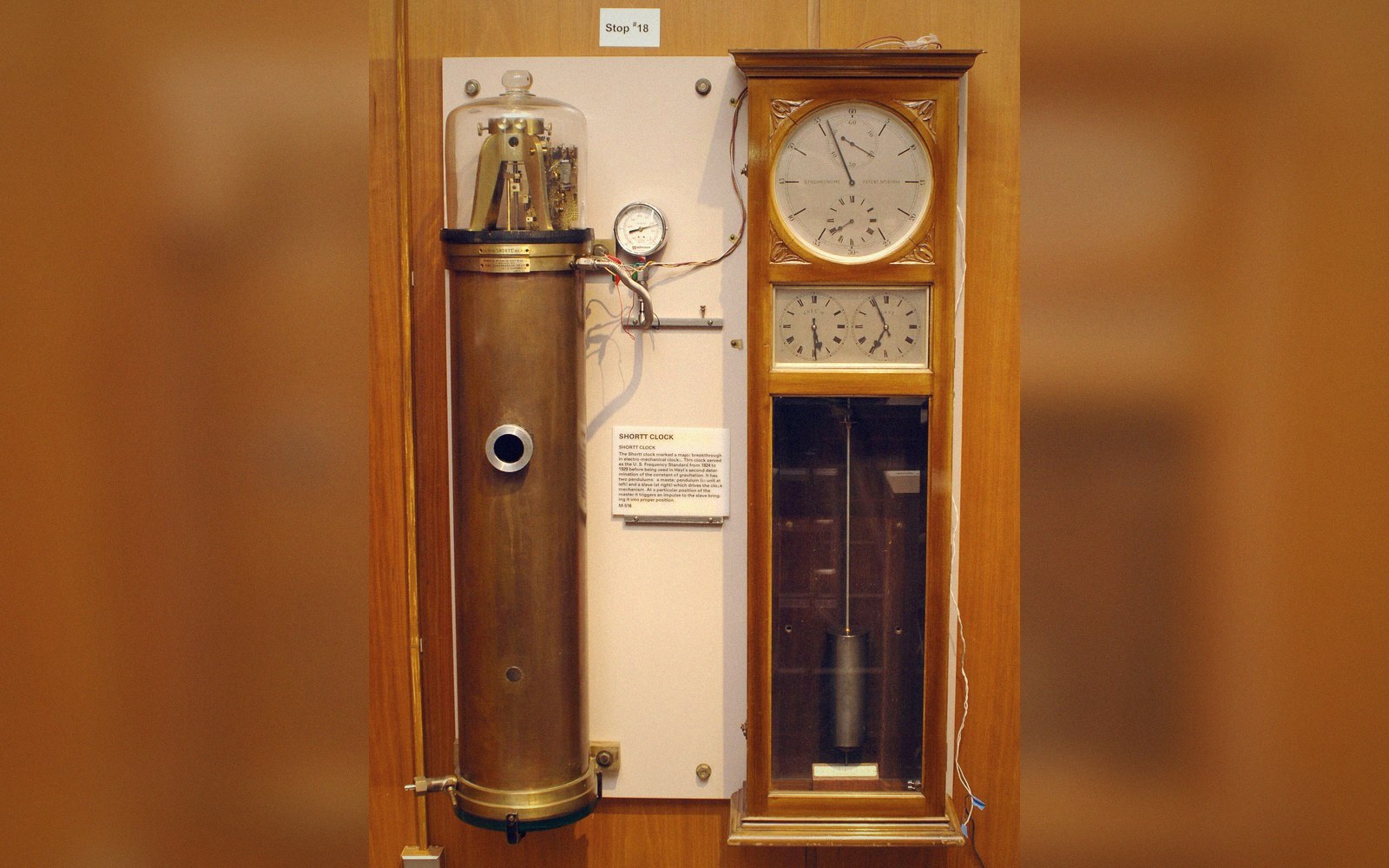
That is precisely what William Hamilton Shortt achieved in 1921. What an escapement does to a pendulum is unavoidable in any conventional clock, because the pendulum and the going train are locked into the same mechanical loop. Shortt's answer was to break that loop entirely: separate the timekeeping pendulum from the mechanical work of running the clock, and let them communicate only by the lightest possible electrical signal — one so brief and so small that it left the regulating pendulum almost unmolested.
02Master and Slave
A Shortt clock is actually two clocks in a single installation. The master unit houses the free pendulum, a long invar rod swinging in a sealed cast-iron case from which most of the air has been evacuated. Removing the air matters because air resistance is not merely a drag on amplitude — it couples the pendulum to changes in barometric pressure, which vary from hour to hour and would otherwise show up in the rate. In near-vacuum, both effects vanish together.
The slave unit, housed in a conventional clock case nearby, does all the mechanical work: it carries a normal pendulum, drives the hands, and manages the release mechanism. The slave swings in the open air and is subjected to every indignity a working escapement imposes. That is acceptable, because the slave's job is not to keep time; it is to give the master an occasional, precisely timed nudge and to translate the master's authority into a useful output.

Once every thirty seconds, the slave releases a small gravity lever — the so-called "free pendulum impulse arm" — that swings into the path of the master pendulum and delivers a brief, repeatable gravitational impulse rather than a friction-based one. A gravity impulse is the preferred method because its magnitude depends only on the weight of the arm and the geometry of the fall, not on the variable forces of springs or trains. The master pendulum receives this push, which takes no more than a fraction of its arc, then swings freely for another thirty seconds with no contact whatsoever. Meanwhile, the slave itself is kept in synchrony by an electrical signal from the master: if the slave drifts ahead or behind, it is corrected at each cycle. Authority runs in one direction. The free pendulum commands; the slave obeys.
The electrical link is elegantly spare. A light platinum-tipped lever on the master pendulum closes a circuit briefly at each swing, sending a low-voltage pulse to the slave. The slave's correcting mechanism compares this pulse against its own position and, if necessary, applies a small correction.
The free pendulum never carries the load of driving this mechanism — the circuit is closed by the pendulum's own passage, requiring no additional force.
IV · Free Pendulum · The Shortt Free Pendulum
03What the Shortt Revealed
The Royal Observatory at Greenwich installed several Shortt clocks from the early 1920s onward, and they immediately displaced every previous standard. Earlier observatory pendulums — including the fine Riefler clocks that had served Greenwich well — had a rate stability measured in hundredths of a second per day. The Shortt achieved a stability closer to a few thousandths of a second per day, roughly an order of magnitude better.
That gain was not merely satisfying to precision engineers; it was scientifically disruptive. Astronomers had long used clocks to time the transits of stars and thus measure the Earth's rotation. The assumption, rarely examined, was that the Earth's spin was the most reliable reference available — that any observed irregularity belonged to the clock. With a Shortt running at Greenwich and others running independently at observatories including the Paris Observatory and the United States Naval Observatory, it became clear that the irregularities were real and belonged to the Earth. The planet's rotation is not constant: it wobbles seasonally, slows slightly through tidal friction, and shows irregular fluctuations that no clock model had been able to reveal before because no clock had been steady enough to serve as the fixed reference.
The Shortt clock thus did something philosophically unusual: it was accurate enough to show that the standard against which all clocks had previously been judged was itself unreliable. The Earth, as a timekeeper, turned out to be the imprecise one.
04The Mechanism Behind the Stability
Several design decisions compounded each other to achieve this result. The pendulum rod is made of invar, the nickel-iron alloy developed in the 1890s by Charles Édouard Guillaume, whose near-zero coefficient of thermal expansion solved the temperature problem that had previously required elaborate compensation mechanisms such as the gridiron of alternating rods. With invar, the rod's length is almost unaffected by temperature changes, so the rate is almost unaffected by them. The evacuated case removes the atmospheric coupling. The gravity impulse replaces the mechanically noisy push of a conventional escapement with something reproducible. The slave takes every penalty for doing real mechanical work, leaving the master pristine.
The result was a pendulum that was, in the language of horology, genuinely free: free from air, free from the escapement's recurrent interference, free from temperature-driven length change, free from the mechanical demands of driving an output. What remained was the pendulum itself, and what the pendulum itself could do turned out to be extraordinary.
The Synchronome Company, whose founder Frank Hope-Jones collaborated closely with Shortt on the practical realisation of the design, manufactured the clocks commercially, and around a hundred were made. They served as primary frequency standards at the world's major observatories until quartz oscillators overtook them in the late 1930s and 1940s. By then, the Shortt had already done its most important work — not by keeping the time, exactly, but by being steady enough to show what time actually is.
External references: Royal Observatory collections, Royal Museums Greenwich; Guillaume Nobel Prize lecture, 1920, NobelPrize.org; US Naval Observatory history of timekeeping standards; Wikipedia — Shortt–Synchronome clock
Chronology
In order
- 1921Shortt free pendulum clock patented and demonstrated
- Early 1920sRoyal Observatory Greenwich adopts Shortt clocks as primary standards
- ~100 madetotal production by the Synchronome Company
- Late 1930s–1940squartz oscillators displace the Shortt at major observatories