Measuring the Earth
The timekeepers were so accurate they exposed a wobble in the planet itself.
01When the Standard Became the Problem
For most of history, the Earth was the clock. Noon was when the Sun crossed the meridian; a day was one rotation; a second was 1/86,400 of that. The arrangement seemed natural, even tautological — what else would time be?
Then the timekeepers got good enough to notice that the arrangement was wrong.
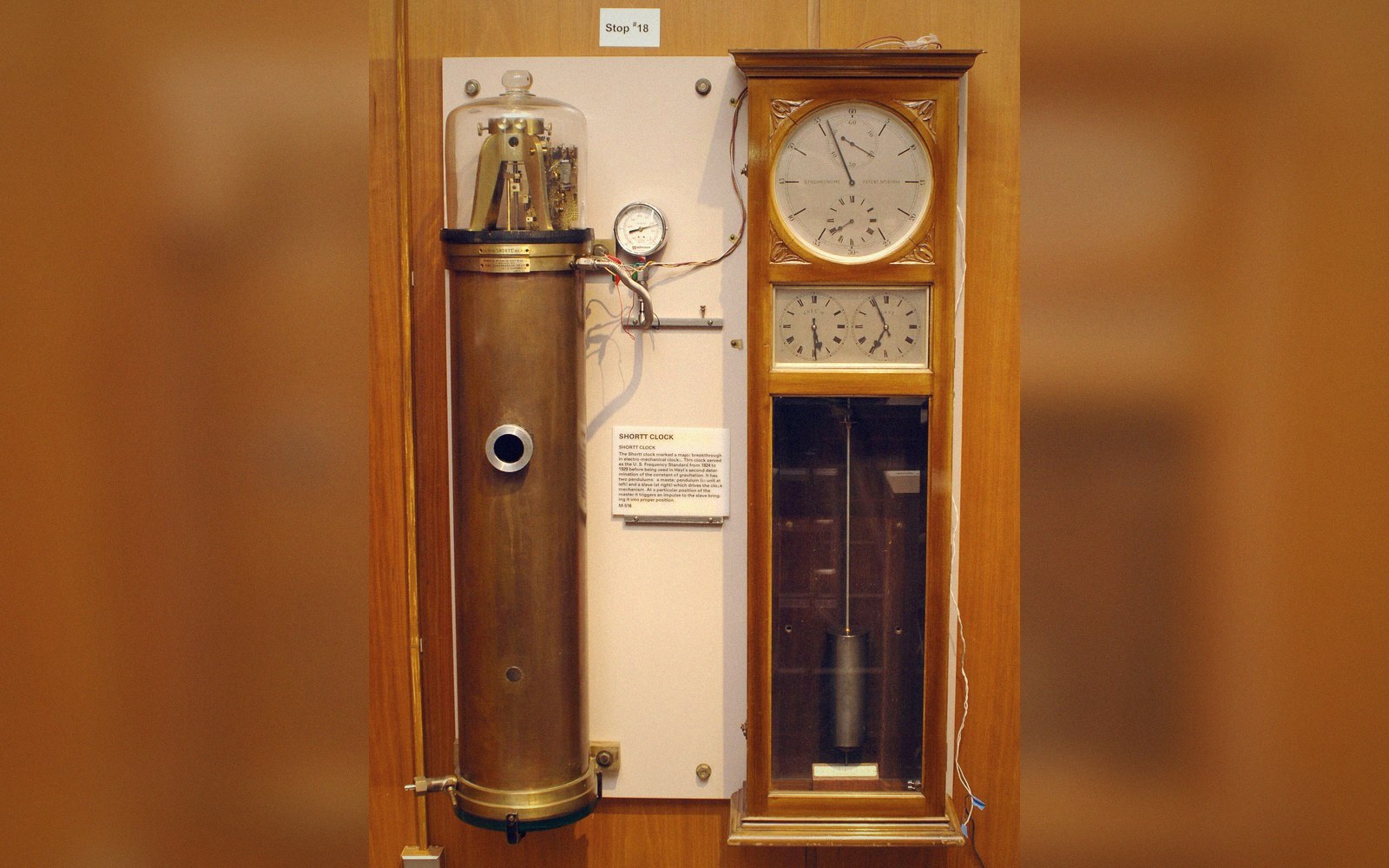
By the early twentieth century, pendulum clocks had reached a daily error measured in thousandths of a second. William Hamilton Shortt's free-pendulum clock, first installed at the Royal Observatory Greenwich in 1925, was accurate to about a second per year — precise enough that astronomers began to notice something disturbing. When they compared networks of these clocks against the Earth's observed rotation, the rotation kept losing the argument. The planet speeded up, slowed down, lurched fractionally. The irregularities were real, not instrumental.
What the clocks were revealing was the Earth's own complexity: tidal friction from the Moon, seasonal shifts in atmospheric mass, the slow redistribution of ice and water across the surface. The length of a day is not constant. It varies by milliseconds that accumulate, and those milliseconds matter to navigation, to longitude, to the coordination of every network that depends on synchronized time.
The consequence arrived formally in 1967, when the International System of Units redefined the second. It was no longer a fraction of the solar day. It became 9,192,631,770 cycles of the radiation emitted by a caesium-133 atom — a definition founded on atomic physics, not planetary motion. The Earth had been fired from the job it had held since the first sundial.
It still shapes the calendar. The clock won, and the planet needed editing.
Leap seconds are inserted whenever the two timescales drift more than 0.9 seconds apart, a bureaucratic patch on a geological reality.
IV · Free Pendulum · Measuring the Earth

Chronology
In order
- 1925Shortt free-pendulum clock installed at Royal Observatory Greenwich
- 1967SI second redefined by the 13th General Conference on Weights and Measures, based on caesium-133 radiation
Read next in IV · Free Pendulum
3 entries in this section · section page- IV · Free PendulumThe Shortt free pendulumTwo pendulums, one doing nothing but swinging in vacuum while a slave does the work — accurate enough to reveal irregularities in the Earth's own rotation.Read the entry →
- IV · Free PendulumWhy vacuumAir resistance and changing barometric pressure both change the rate.Read the entry →