Why Vacuum
Remove the air and you remove two distinct problems at once: drag that slows the pendulum and pressure that changes its rate unpredictably.

01The Two Enemies in Every Atmosphere
A pendulum swinging in open air is fighting something it cannot see. Air has mass, and a moving bob has to push it out of the way on every half-swing. That resistance — aerodynamic drag — does what any friction does to an oscillator: it shortens the arc. A shorter arc would not matter if the pendulum were perfectly isochronous, meaning its period truly independent of amplitude. No real pendulum quite is. As the arc shrinks under drag, the period changes too, and the clock's rate drifts.
This is the first problem. It is chronic, steady, and partly manageable. Makers shaped bobs to cut through air more cleanly — the lens-shaped or biconvex bob became standard on precision clocks precisely because its edge presents less frontal area than a flat disk. It does not eliminate the drag; it merely reduces how much there is to fight.
The second problem is nastier because it is invisible and erratic. Barometric pressure is not constant. On a calm high-pressure morning it might read 1030 millibars; during a deep Atlantic low it can fall to 970 or below. Air at higher pressure is denser, and a denser medium provides more buoyancy to the bob and more resistance to its motion. Both effects change the effective mass the pendulum swings and the force the air exerts against it. The net result is that the rate — the clock's daily gain or loss — shifts with the weather. A clock regulated on a bright anticyclone day will run slightly fast when the depression arrives, not because anything inside it has changed, but because the atmosphere around it has.
Quantifying this sensitivity matters enormously once you are trying to measure time to the accuracy that defines the shape of the Earth or the position of a star. The Royal Observatory Greenwich accumulated decades of observations that showed barometric pressure variation could account for measurable error in even the best precision regulators. The problem was known, named and frustrating long before anyone solved it.
02The Shortt Answer
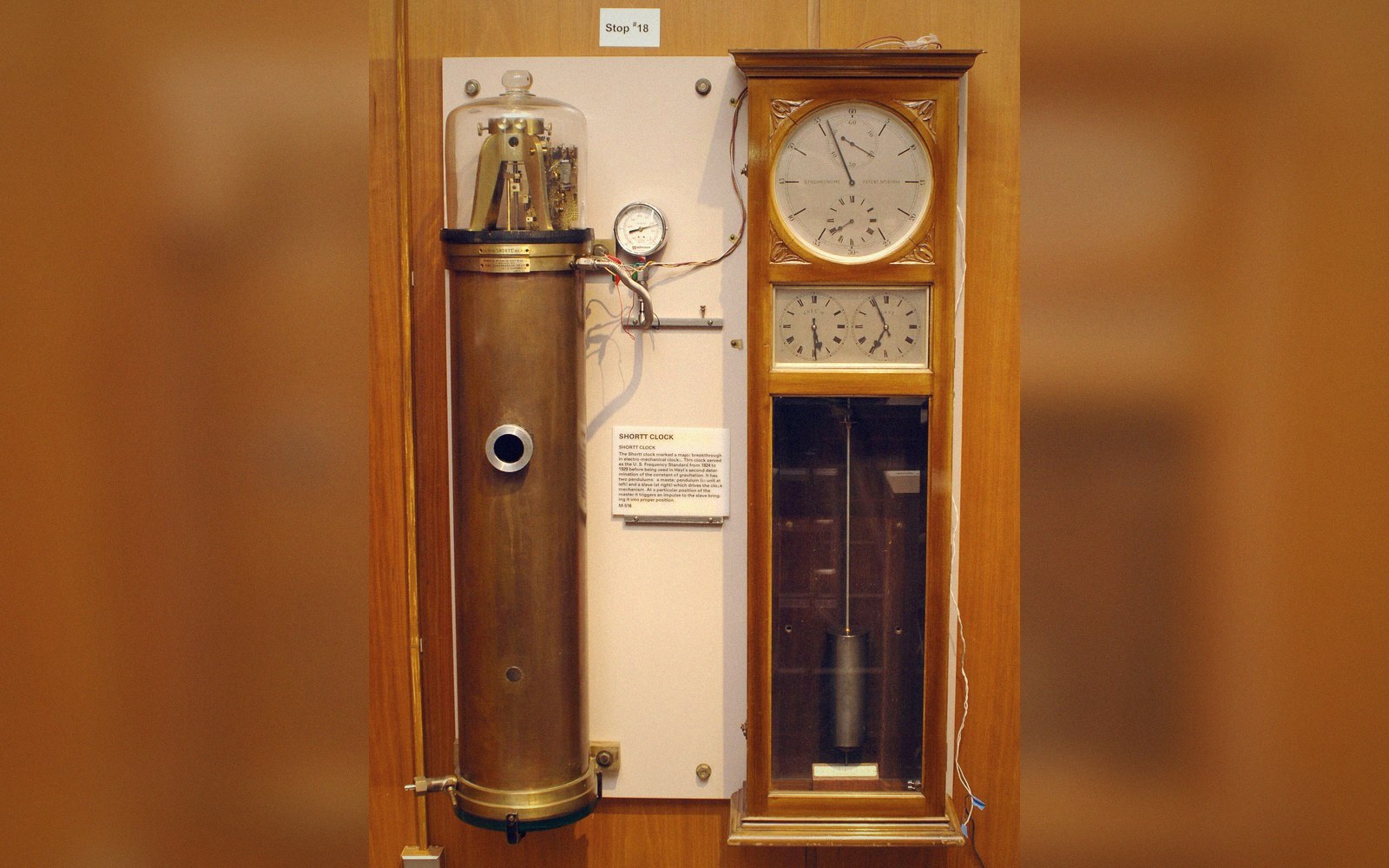
The solution is conceptually simple and mechanically demanding: remove the air. Seal the pendulum in a chamber and evacuate it. With no atmosphere to push through and no barometric pressure to vary, both problems disappear together. Drag falls to whatever remains from the suspension and from the pendulum's own internal flexing; barometric sensitivity falls to zero.
William Hamilton Shortt's free pendulum clock, developed in the early 1920s and built by the Synchronome Company, carried this to its logical conclusion. The master pendulum — the one actually defining the timescale — swings inside a sealed, evacuated tank. It does almost no mechanical work: it does not directly drive any wheel, it does not push any escapement tooth on every beat. A slave clock handles all of that drudgery and receives a small, precisely timed electrical impulse from the master to keep itself synchronised.
Because the master pendulum is almost completely freed from mechanical load, and because its chamber is evacuated, the two main atmosphere-related error sources are simultaneously eliminated.
IV · Free Pendulum · Why Vacuum
The residual instability in a Shortt clock operating in good conditions was measured in milliseconds per day — a performance that held as the world standard for precision timekeeping until quartz oscillators arrived. The Royal Observatory Greenwich installed Shortt clocks for exactly this reason; they were the backbone of observatory timekeeping through the 1930s and 1940s.
Vacuum also removes another subtler nuisance: air currents. Any open pendulum clock in a room is subject to draughts, to the convective columns rising from a warm body or a lamp, to the slow seasonal shifts in a building's ventilation. Seal the pendulum away and all of that vanishes. The chamber gives thermal stability too: the sealed volume changes temperature more slowly and more uniformly than open air, reducing the temperature gradients that cause uneven expansion in the rod and bob.

The irony is elegant. Clockmakers spent centuries making better pendulums — gridiron compensation, invar rods, carefully shaped bobs — and the final step toward perfection was simply to take the pendulum out of the world it had always lived in, and give it nothing to push against at all.
Chronology
In order
- Early 1920sShortt and the Synchronome Company develop the free pendulum clock
- 1930s–1940sShortt clocks serve as the primary timekeeping standard at the Royal Observatory Greenwich
- Post-WWIIquartz oscillators eventually supersede the Shortt as the world's most accurate timekeepers
Read next in IV · Free Pendulum
3 entries in this section · section page- IV · Free PendulumThe Shortt free pendulumTwo pendulums, one doing nothing but swinging in vacuum while a slave does the work — accurate enough to reveal irregularities in the Earth's own rotation.Read the entry →
- IV · Free PendulumMeasuring the EarthWhen the clock beat the planet, the planet turned out to be the unreliable one.Read the entry →